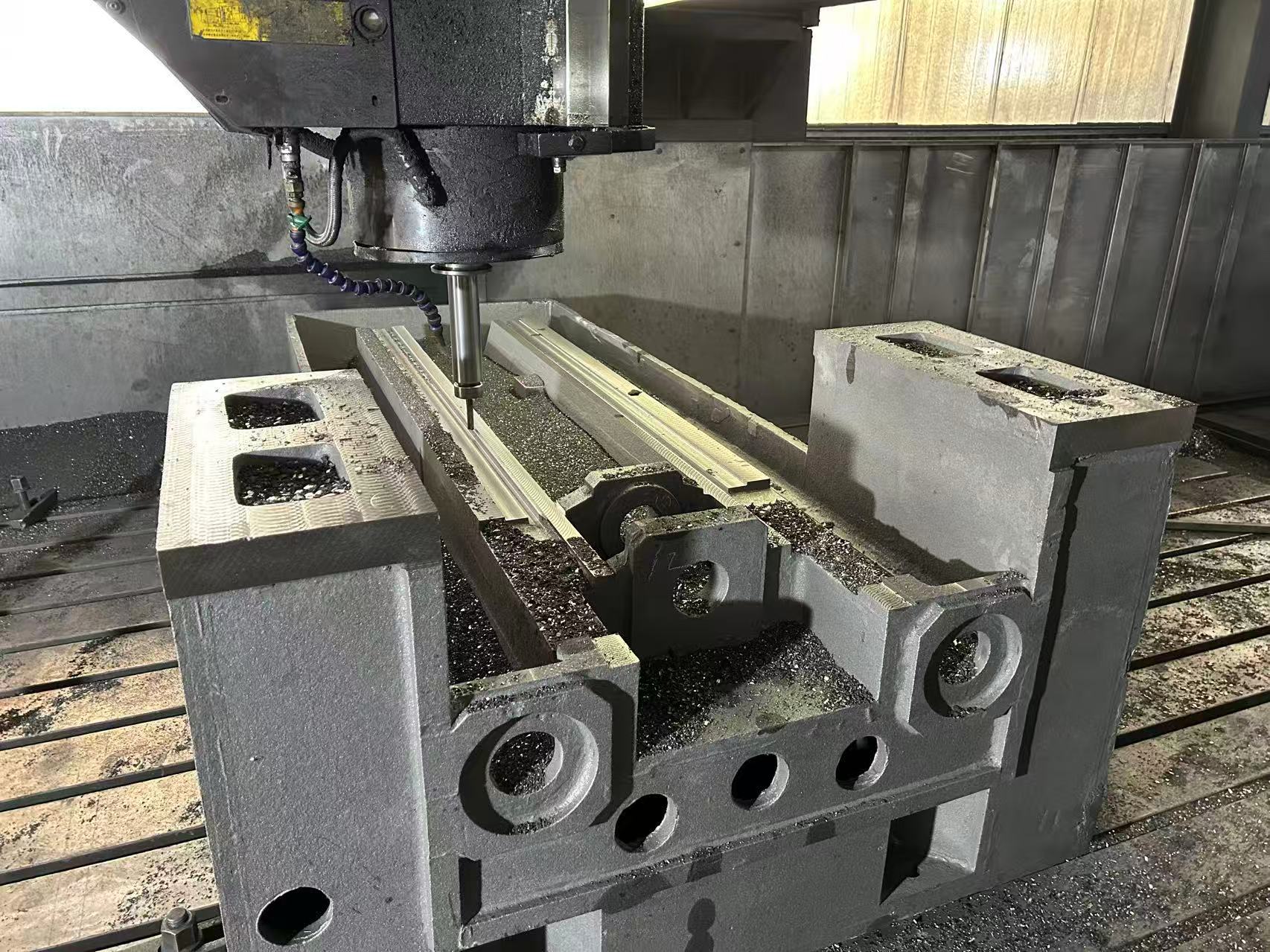
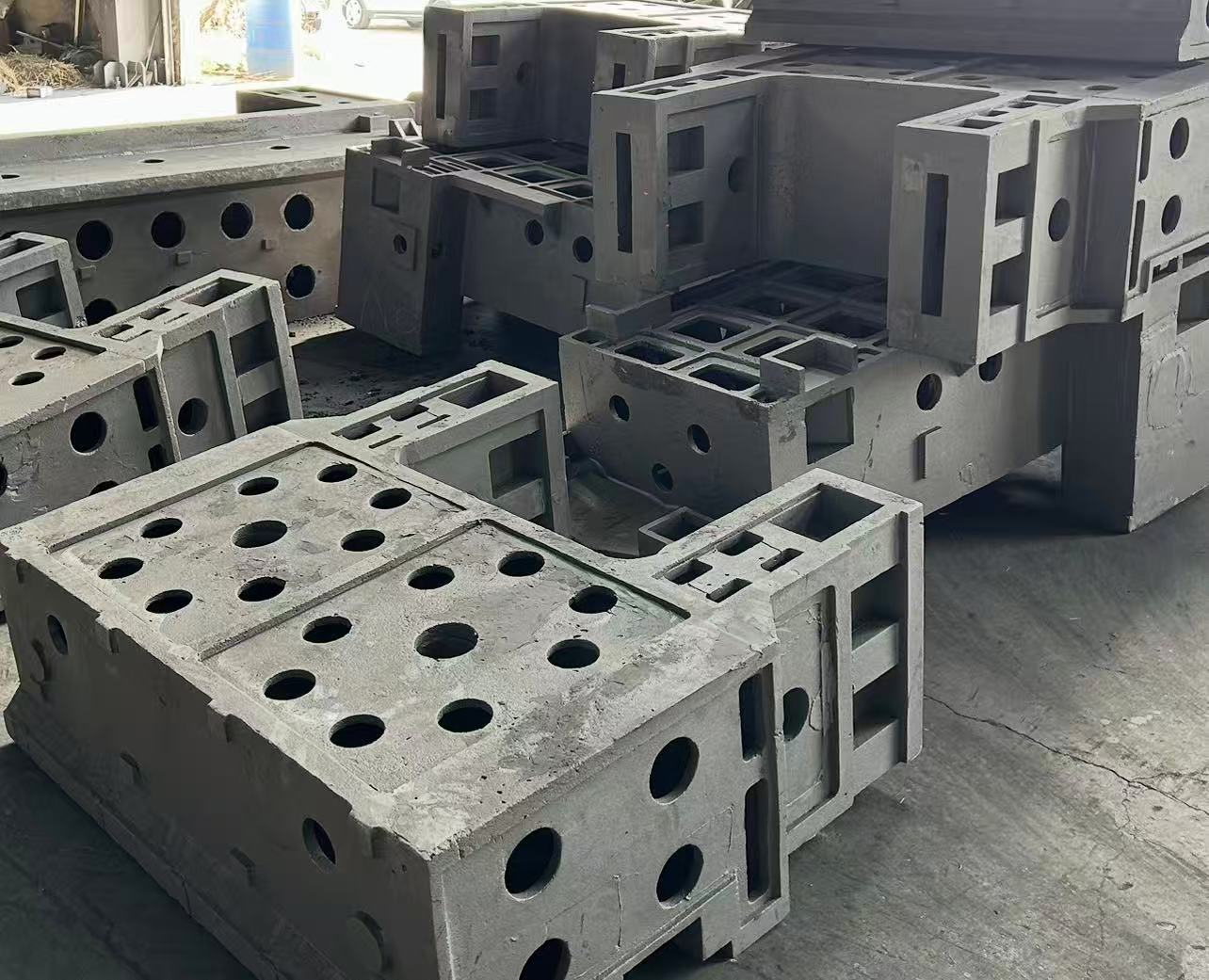
Overview of the Solution
This cast iron machine tool housing and base assembly is specifically designed for CNC lathes, vertical/horizontal machining centers, gantry milling machines, gear processing machines, and other equipment. With “synergistic adaptation of machine tool housing – base assembly + high-rigidity cast iron material + precision manufacturing process” as the core, it overcomes the four major pain points of traditional components: “insufficient housing rigidity leading to transmission errors, poor sealing resulting in easy oil leakage, insufficient base load-bearing capacity causing settlement, and difficulty in leveling affecting precision”.
High-quality materials are carefully selected, including QT500-7/QT600-3 ductile iron (the main material for housings) and HT300-HT400 gray cast iron (for conventional bases). Through processes such as “CNC boring and milling + precision grinding + aging strengthening”, the tolerance of the housing bearing holes reaches H7, the sealing grade is IP65, the base load-bearing capacity is 15-100 tons, the leveling accuracy is ±0.001mm/m, and the long-term operation precision attenuation rate of the entire set of components is ≤0.05% per year.
It covers industries such as general machinery, auto parts, precision molds, and aerospace. It helps to improve the machine tool transmission precision by 40%, reduce the oil leakage failure rate by 80%, and shorten the equipment installation cycle by 35%.
Core Function System (Focusing on the Synergistic Adaptation of “Housing – Base”)
1. Advantages of Cast Iron Materials and Exclusive Processes
- Hierarchical Material Selection (Adapting to Functional Differences of Components):
◦ Machine Tool Housings (Mainly QT500-7/QT600-3 Ductile Iron): The tensile strength is ≥500MPa (for QT500-7) / 600MPa (for QT600-3), the elongation is ≥7% / 3%, and the toughness is 2-3 times that of gray cast iron. It has excellent fatigue resistance (capable of withstanding 10⁶ transmission impacts), making it suitable for scenarios such as spindle housings and gearboxes that need to accommodate transmission components. The inner wall finish is Ra≤1.6μm, which reduces the resistance of lubricating oil and avoids sludge accumulation. For special high-temperature scenarios (such as high-speed spindle operation), HT400 gray cast iron (with a hardness of 200-260HB and excellent thermal conductivity) can be selected.
◦ Base Assemblies (HT300-HT400 Gray Cast Iron / QT500-7 Ductile Iron): For conventional load-bearing (15-50 tons), HT300-HT400 is selected (the shock absorption coefficient is 3-5 times that of steel, absorbing equipment vibration). For heavy-duty load-bearing (50-100 tons), QT500-7 is chosen (with strong anti-settlement ability, and the long-term load-bearing deformation is ≤0.003mm/m). Leveling holes and shock absorption installation grooves are reserved at the bottom of the base to adapt to different ground conditions.
- Exclusive Manufacturing Processes (Ensuring Precision and Stability):
◦ Machine Tool Housings: The “resin sand molding + lost foam casting” process (for complex housings) is adopted to reduce internal air holes (defect rate ≤0.3%). The bearing holes and gear installation positions undergo “rough boring – semi-finish boring – finish boring – honing” processing, with a hole diameter tolerance of H7 and a roundness of ≤0.002mm, ensuring the coaxiality of transmission components (spindles, gears). The sealing surface is precision ground (Ra≤0.8μm) to improve the sealing fit.
◦ Base Assemblies: After 60-90 days of natural aging + 2 times of artificial aging (holding at 550-600℃ for 8 hours), more than 99% of internal stress is eliminated, avoiding base bending caused by stress release during long-term use (10-year deformation ≤0.01mm/m). The installation surface undergoes “finish milling – grinding”, with a flatness of ≤0.008mm/1000mm, ensuring the positioning accuracy with the housing.
2. Machine Tool Housings: Transmission System Protection and Precision Assurance
(1) High-Rigidity Structural Design (Resisting Transmission Impact)
- Optimization of Box Wall Thickness and Reinforcing Ribs: The wall thickness (15-30mm) is designed according to the transmission power. Heavy-duty housings such as spindle housings adopt a “double-layer box wall + cross-shaped reinforcing ribs” design (rib spacing 150-300mm). For example, for a machining center spindle housing (size 800×600×500mm), the bending stiffness is increased by 70%, and the vibration amplitude of the housing is ≤0.002mm when the spindle runs at high speed (15000rpm), avoiding changes in the meshing gap of transmission gears (error ≤0.001mm).
- Local Strengthening Treatment: The periphery of bearing holes and gear installation bosses undergo “local thickening + quenching” (hardness 45-50HRC) to improve local load-bearing capacity and avoid hole deformation caused by long-term stress (bearing hole service life ≥50,000 hours).
(2) Precision Sealing and Oil Control Design (Preventing Leakage)
- Multi-Layer Sealing Structure: The spindle extension end adopts a double protection of “lip seal + labyrinth seal”, with a sealing grade of IP65, which can prevent cutting fluid and dust from entering, and reduce the oil leakage failure rate from 25% (traditional) to less than 5%. The joint surface of the housing uses oil-resistant asbestos gaskets + sealant (temperature resistance -30℃~150℃) to ensure no leakage at the joint surface.
- Oil Control and Heat Dissipation Adaptation: Lubricating oil channels (hole diameter 8-15mm) are set in the housing to adapt to the automatic lubrication system and accurately supply oil to gears and bearings. Large housings (such as gantry milling machine spindle housings) integrate heat dissipation fins (heat dissipation area ≥1.5 times the housing surface area) or reserve cooling water channels (hole diameter 10-20mm) to avoid excessive temperature rise of lubricating oil (oil temperature controlled at ≤60℃) affecting viscosity.
(3) Adaptation to Transmission Components (Precision Installation)
- Precision Machining of Installation Positions: The bearing hole tolerance is H7, the roundness is ≤0.002mm, and the coaxiality is ≤0.003mm (for multi-bearing holes), ensuring the precise installation of spindle bearings (such as angular contact ball bearings), and the spindle radial runout is ≤0.001mm. The gear installation shaft hole tolerance is js6, and the fit gap with the gear shaft is ≤0.005mm, reducing transmission impact and noise (noise ≤75dB).
- Internal Space Optimization: The internal cavity is designed according to the layout of the transmission system (such as spindle, gear, clutch), and maintenance space (≥150mm) is reserved to facilitate the disassembly and assembly of components. Large housings are equipped with observation windows (tempered glass + sealing cover) to allow real-time viewing of the internal transmission status and reduce downtime for inspection.
3. Base Assemblies: Overall Support and Stable Adaptation
(1) Multi-Scenario Load-Bearing and Leveling Design
- Optimization of Load-Bearing Structure: Conventional bases adopt a “box-type main structure + grid ribs” design (rib spacing 200-400mm) to bear 15-50 tons. Heavy-duty bases (such as 10m CNC lathe bases) adopt a “box-type structure + honeycomb dense ribs” design to bear 50-100 tons, with a long-term load-bearing settlement of ≤0.005mm per year.
- Flexible Leveling Methods:
◦ Pad Iron Leveling Bases: Equipped with cast iron leveling pad irons (adjustment range 0-20mm, load-bearing ≤25 tons per set), fine-tuned by bolts, with a leveling accuracy of ±0.001mm/m, adapting to workshops with general ground flatness (concrete strength ≥C25).
◦ Shock Absorption Leveling Bases: For precision machine tools (such as coordinate boring machines), air spring shock absorption modules (shock absorption efficiency ≥90%) are installed at the bottom to isolate ground vibrations (such as the operation of other equipment in the workshop) and ensure machine tool machining accuracy (repeat positioning error ≤0.002mm).
◦ Embedded Fixed Bases: Heavy-duty machine tools (such as gantry milling machines) are equipped with embedded bases, which are fixed to the ground concrete (C30 or above) through anchor bolts (M30-M60) to enhance overall stability and prevent machine tool movement (displacement ≤0.001mm per year).
(2) Precise Positioning Coordination with Housings
- Positioning Structure Design: Positioning pin holes (tolerance H7) are set on the top of the base, which are matched with the spigot at the bottom of the housing, with a positioning error of ≤0.005mm, ensuring the coaxiality of the housing and the base (≤0.003mm/1000mm) and avoiding transmission errors caused by assembly deviations.
- Protection and Expansion Adaptation: Guardrail installation grooves (adapting to safety protection) are set around the base, and chip conveyor interfaces (cross-section 150×200mm-300×400mm) are reserved to facilitate the integration of the machine tool chip removal system. Some bases are equipped with hoisting holes (load-bearing ≤1.5 times the base weight) to facilitate overall handling and installation.
Core Composition of the System
| Categoría de componentes |
Core Parameters and Configuration (Enhanced Synergistic Characteristics) |
| Cast Iron Machine Tool Housings |
Material: QT500-7/QT600-3 ductile iron, HT400 gray cast iron; Size: Length 500-2000mm, Width 400-1500mm, Height 300-1200mm; Precision: Bearing hole tolerance H7, Roundness ≤0.002mm, Coaxiality ≤0.003mm; Sealing: Grade IP65, adapting to lip seal + labyrinth seal; Structure: Double-layer box wall/reinforcing ribs, lubricating oil channels, optional heat dissipation fins |
| Cast Iron Base Assemblies |
Material: HT300-HT400 gray cast iron, QT500-7 ductile iron; Type: Pad iron leveling type / Shock absorption leveling type / Embedded type; Size: Length 1500-10000mm, Width 800-5000mm, Height 300-1000mm; Precision: Installation surface flatness ≤0.008mm/1000mm, Leveling accuracy ±0.001mm/m; Load-bearing: 15-100 tons (per set) |
| Auxiliary Accessories |
Oil-resistant seals (material: nitrile rubber/fluororubber, temperature resistance -30℃~200℃); Cast iron leveling pad irons (adjustment range 0-20mm, load-bearing ≤25 tons per set); Air spring shock absorption modules (shock absorption efficiency ≥90%, load-bearing ≤50 tons per set); Anchor bolts (M30-M60, Grade 10.9, adapting to embedded installation) |
Casos típicos de aplicación industrial
- Vertical Machining Center Spindle Housing + Base: Used by a machine tool factory for 850-type vertical machining centers —— The spindle housing is made of QT500-7 material (size 800×600×500mm), with a bearing hole tolerance of H7 and a sealing grade of IP65; it is matched with an HT400 shock absorption base (2000×1500×800mm) with a leveling accuracy of ±0.001mm/m. When the spindle runs at 15000rpm, the vibration amplitude is ≤0.002mm, the hole position tolerance of processed molds is reduced from ±0.008mm to ±0.003mm, the oil leakage failure rate is reduced from 20% to 3%, and the equipment maintenance cycle is extended by 2 times.
- 10m Heavy-Duty CNC Lathe Base + Spindle Housing: Used by a heavy industry enterprise for φ2000mm CNC lathes —— The spindle housing is made of QT600-3 (impact load resistance ≥500kN), and the base is an embedded QT500-7 base (10000×3000×1000mm) with a load-bearing capacity of 100 tons. When processing wind power spindles (φ1800mm), the spindle radial runout is ≤0.001mm, the cylindricity error is reduced from ±0.015mm to ±0.005mm, the annual base settlement is ≤0.005mm, and the machine tool precision retention period is extended from 1 year to 4 years.
- Precision Gear Processing Machine Housing: Used by a gear factory for gear hobbing machines —— The housing is made of QT500-7 (size 600×500×400mm), the gear installation shaft hole tolerance is js6, and the coaxiality is ≤0.003mm. When processing precision gears (module 5, precision grade 6), the cumulative pitch error is reduced from ±0.012mm to ±0.005mm, the transmission noise is reduced from 85dB to 72dB, and the gear qualification rate is increased by 35%.
Ventajas competitivas principales
- High Synergistic Precision of “Housing – Base”: The base and housing are precisely matched through positioning pins (error ≤0.005mm), avoiding transmission errors caused by assembly deviations, which is far better than the splicing structure of “purchased housing + general base” (deviation ≥0.01mm), ensuring the stable overall precision of the machine tool.
- Strong Transmission Protection Capability of the Housing: The ductile iron material has fatigue resistance, high-precision sealing prevents leakage, and the bearing holes are precisely adapted to transmission components. The transmission error is reduced by 40%, and the oil leakage failure rate is reduced by 80%, solving the core pain points of traditional housings such as “inaccurate transmission and easy oil leakage”.
- Flexible Load-Bearing and Leveling of the Base: Multiple types of bases adapt to different load-bearing capacities (15-100 tons) and ground conditions, with a leveling accuracy of ±0.001mm/m and a load-bearing settlement of ≤0.005mm per year. The stability is 3 times higher than that of welded bases (insufficient load-bearing and easy deformation).
- Excellent Cost and Maintenance Benefits: The purchase cost of cast iron materials is 20% lower than that of steel, and integrated manufacturing reduces assembly processes. The housing has good sealing performance, and the base does not require frequent leveling. The annual maintenance cost is less than 1/3 of that of welded components, and the full-life cycle cost is 40% lower.
- Wide Customization Adaptability: It supports the customization of housing size (500-2000mm), number of bearing holes, and sealing grade, as well as the customization of base load-bearing (15-100 tons) and leveling method. The structure can be optimized according to the machine tool model (such as FANUC/SIEMENS system), adapting to more than 95% of machine tool needs.
Full-Dimensional Customization Services
- Component Parameter Customization:
◦ Machine Tool Housings: Size 500-2000mm (length × width × height), number of bearing holes (1-6), sealing grade (IP54-IP67), layout of lubricating oil channels, adapting to different transmission systems.
◦ Base Assemblies: Size 1500-10000mm (length × width × height), load-bearing 15-100 tons, leveling method (pad iron / shock absorption / embedded), adapting to different machine tool weights and ground conditions.
- Material and Process Customization:
◦ Material Selection: QT500-7 is usually selected for the housing, QT600-3 for heavy loads, and HT400 for high-temperature scenarios; HT300-HT400 is usually selected for the base, and QT500-7 for heavy loads.
◦ Process Enhancement: Honing of housing bearing holes (Ra≤0.4μm), surface quenching (hardness 45-50HRC); ultra-long time aging of the base (90-120 days), precision grinding of the installation surface.
- Supporting Service Customization:
◦ Installation and Commissioning: Positioning and assembly of the housing and base, precision inspection of bearing holes, leveling of the base, ensuring that the entire set of components meets the coordination requirements of the machine tool transmission system;