
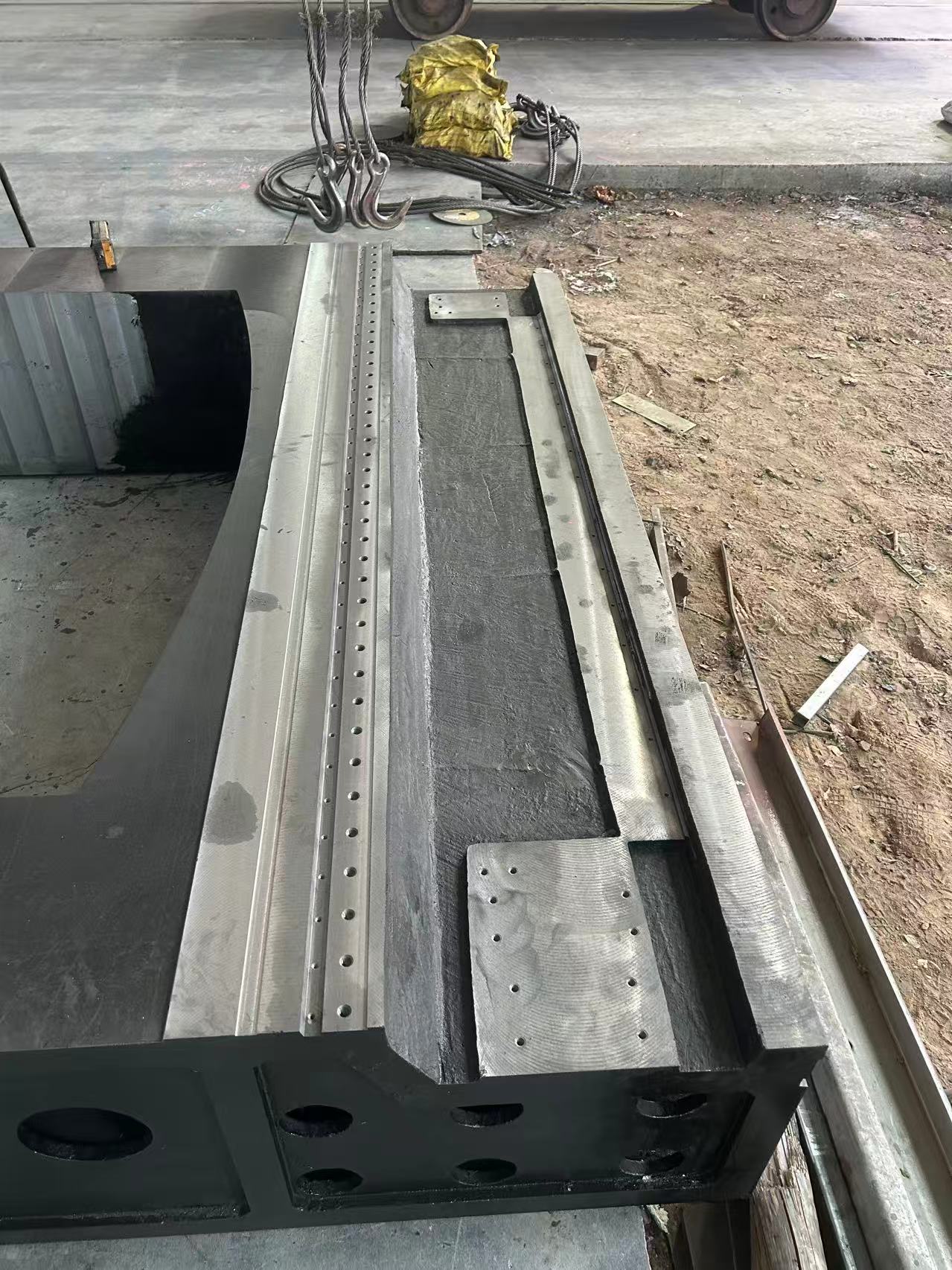
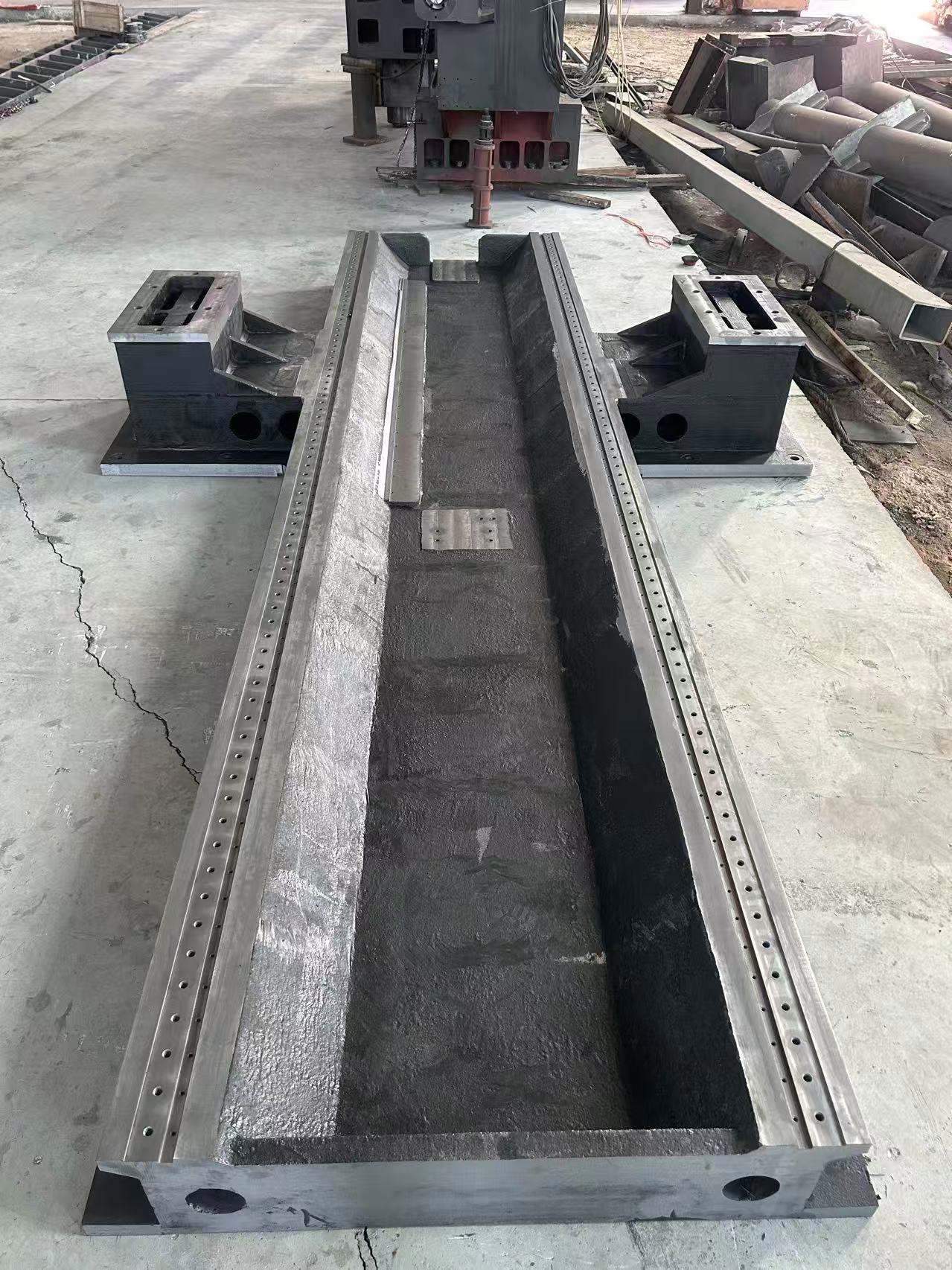
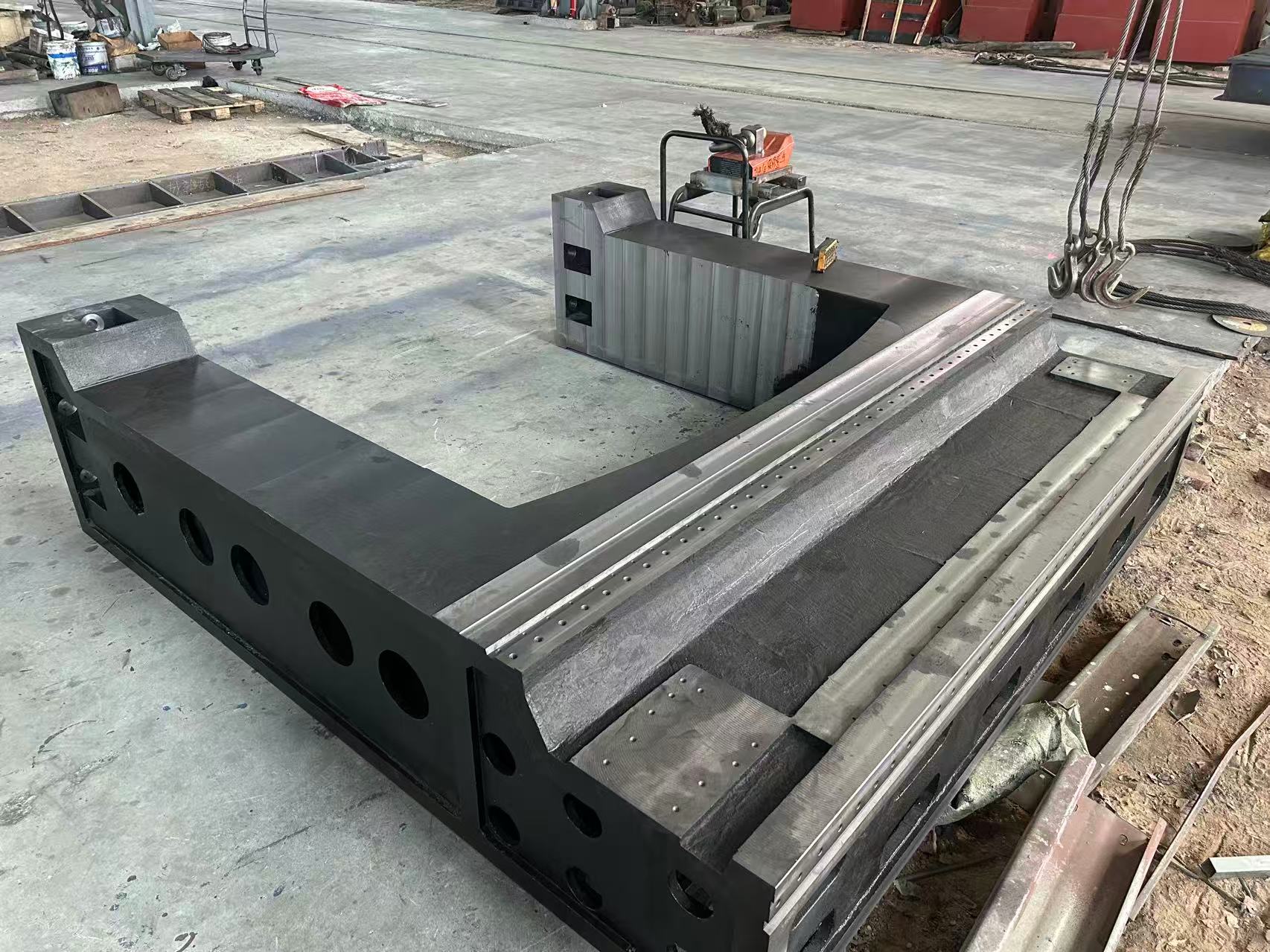
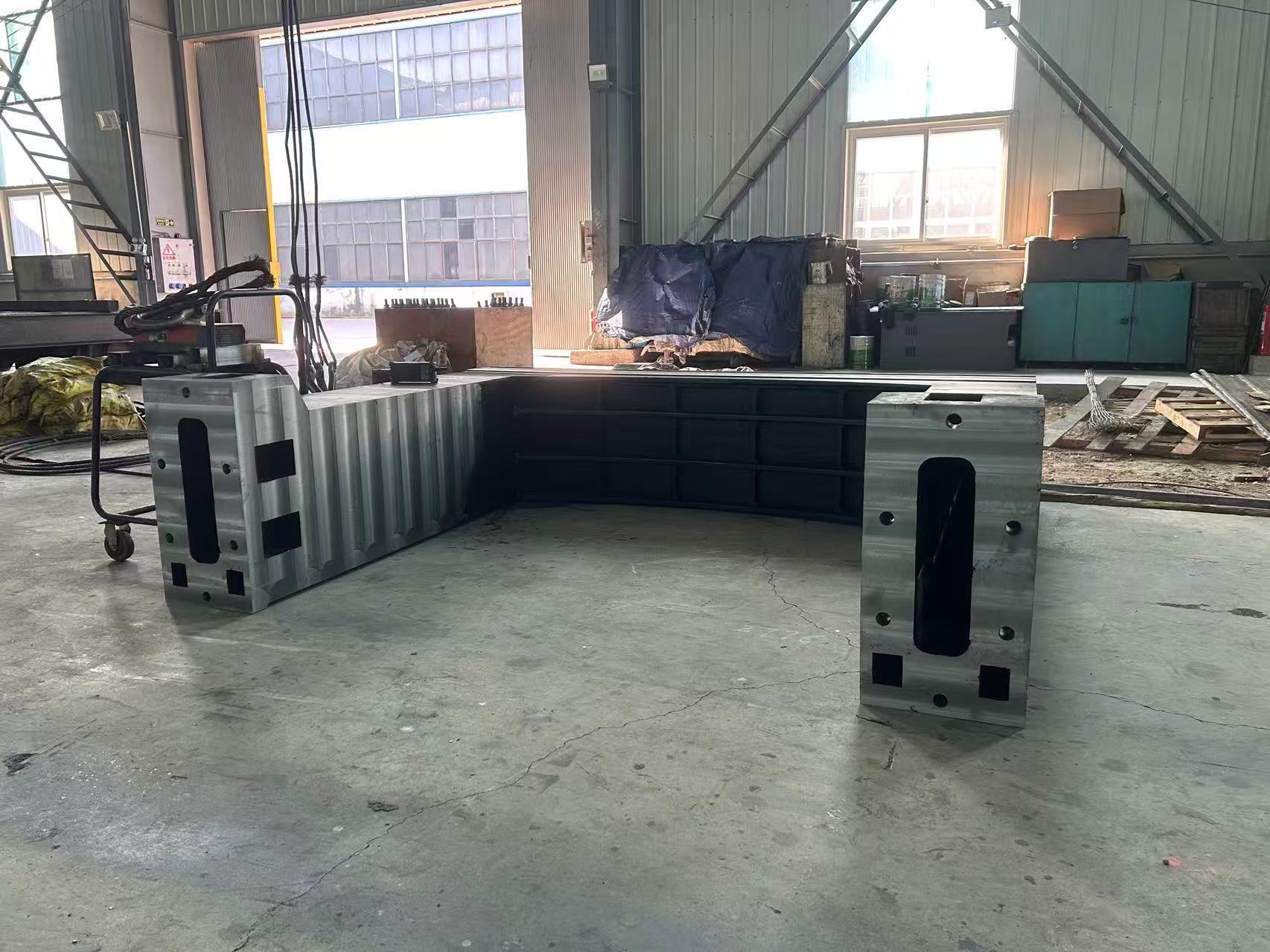
This large cast iron machine tool bed and industrial equipment base is specifically designed for ultra-large-scale equipment such as heavy-duty gantry milling machines, rolling mills, large CNC floor-type boring and milling machines, and heavy-duty testing equipment (e.g., 10m-class coordinate measuring machines). It takes “ultra-load-bearing cast iron material + ultra-large-size precision machining + anti-deformation structural design” as the core, overcoming the three major pain points of traditional large-scale bases: “insufficient load-bearing capacity leading to easy cracking, poor machining accuracy of large sizes, and excessive deformation during long-term use”.
High-strength cast iron (HT350/HT400 gray cast iron, QT600-3 ductile iron) is carefully selected, and combined with the “large CNC gantry milling + floor-type boring and milling” composite machining technology. It can achieve a maximum single-piece size of 12000×5000×1500mm, a load-bearing capacity of 50-200 tons, a flatness of ≤0.01mm/1000mm, and a long-term precision attenuation rate of ≤0.08% per year.
It is suitable for industries such as heavy machinery manufacturing, metallurgy, and aerospace. It helps to increase the machining accuracy of heavy-duty equipment by 25%, extend the service life of equipment by 3 times, and reduce the installation and commissioning cost of large-scale equipment by 30%.
◦ HT350/HT400 Gray Cast Iron: The main material for large machine tool beds. The tensile strength is ≥350MPa (for HT350) / 400MPa (for HT400), and the hardness is 200-260HB. The optimized flake graphite distribution enhances shock absorption (the shock absorption coefficient is 4-6 times that of steel). It can absorb high-frequency vibrations generated by the spindle of heavy-duty machine tools (10000-15000rpm) or during the operation of rolling mills, avoiding vibration marks in the machining of heavy workpieces. It is suitable for beds/bases with a single-piece weight of ≤50 tons and a size of ≤8000×4000mm.
◦ QT600-3/QT700-2 Ductile Iron: The core material for heavy-duty equipment bases (such as rolling mill bases and large testing machine bases). The tensile strength is ≥600MPa, the elongation is ≥3%, and the toughness is 3-4 times that of gray cast iron. It can withstand 200-ton-level impact loads (such as rolling force during steel rolling and hoisting impact of heavy workpieces), preventing cracking of large bases. With a hardness of 220-280HB, it has both anti-fatigue and wear-resistant properties.
◦ Process Guarantee for Large Castings: The “resin sand negative pressure molding + lost foam casting” composite process (for complex large parts) is adopted to reduce air holes and shrinkage defects in large castings (defect rate ≤0.3%). After 90-120 days of natural aging (50% longer than conventional castings) + 3 times of artificial aging treatment, more than 99.5% of internal stress is eliminated, avoiding long-term deformation of large structures due to stress concentration (deformation ≤0.1mm/m in 10 years).
To address the problem of thermal deformation sensitivity of large parts, through “gradient wall thickness design” (the wall thickness of key load-bearing parts is 50-100mm, and that of non-load-bearing parts is 30-50mm) and “integrated heat dissipation ribs”, the thermal deformation of a 10m-long base is controlled within ≤0.005mm/m (with an ambient temperature fluctuation of ±10℃). The surface adopts a three-layer protection of “sandblasting derusting + epoxy primer + wear-resistant topcoat”, which can pass a salt spray test of ≥720 hours, adapting to the high-temperature, high-dust environment of metallurgical workshops and the cutting fluid erosion environment of heavy machine tool workshops.
The “large CNC gantry milling machine (stroke 12000×5000×1500mm) + floor-type boring and milling machine (spindle torque 800N・m)” composite machining scheme is adopted, equipped with Swiss THK heavy-duty guide rails and German Heidenhain gratings (resolution 0.0001mm), achieving:
◦ Machining of Guide Rails for Large Machine Tool Beds: The single machining length of rectangular/V-shaped guide rails is ≤8000mm, the straightness of the guide rails is ≤0.008mm/1000mm (the straightness of the total length of 3000mm is ≤0.02mm), and the surface roughness is Ra≤3.2μm (suitable for heavy-duty scenarios). The guide rail spacing tolerance is ±0.01mm, ensuring stable movement of heavy-duty sliding tables (weight ≤30 tons) without jamming.
◦ Machining of Mounting Surfaces for Industrial Equipment Bases: The flatness of the equipment mounting surface of large bases (such as 6000×3000mm rolling mill bases) is ≤0.01mm/1000mm, and the positional tolerance of hole systems (φ50-φ200mm positioning holes) is ±0.015mm. It is suitable for fixing the anchor bolts and positioning pins of heavy-duty equipment, reducing the on-site installation and leveling time.
◦ Splicing Machining of Ultra-Large Parts: For ultra-large bases with a length of ≥10m (such as 12m-long large coordinate measuring machine bases), the “block casting + on-site splicing” technology is adopted. The splicing surfaces are positioned with spigots and fastened with high-strength bolts. The step error at the splicing joint is ≤0.005mm, and the overall flatness is ≤0.015mm/1000mm, meeting the overall precision requirements of ultra-large equipment.
The six-step process of “rough milling – stress relief annealing – semi-finish milling – aging treatment – finish milling – lapping” is adopted: after removing 70% of the allowance by rough milling, stress relief annealing is carried out (holding at 550-600℃ for 8 hours) to avoid deformation of large castings due to stress release after machining. After finish milling, a 0.2-0.3mm lapping allowance is reserved on the large surface, and overall polishing is performed by a large flat lapping machine (lapping area ≤10m²) to ensure the uniformity of flatness and smoothness of the large surface.
◦ Box-Type/Honeycomb Rib Reinforcement: Large bases adopt a “box-type main structure + honeycomb-shaped reinforcing ribs” design (rib spacing 200-400mm). For example, a 6000×3000×800mm rolling mill base has a 60% increase in bending stiffness. When bearing a 150-ton rolling mill for a long time, the deformation is ≤0.003mm/m, avoiding base sinking caused by rolling force.
◦ Adaptation to Hoisting and Transportation: Standardized hoisting points are reserved (load-bearing ≥50 tons per point, distributed at the four corners of the base). For ultra-wide/ultra-long parts (such as 8000×4000mm beds), the “block design + on-site splicing” is adopted, and the maximum transportation weight of a single block is controlled within 30 tons, adapting to road/railway transportation restrictions. Positioning pin holes and sealing grooves are reserved at the splicing joints to ensure the overall sealing of the spliced base (suitable for equipment bases with cooling water circuits).
◦ Large Gantry Milling Machine Beds: Made of HT400 material, with a size of 6000×3000×800mm, guide rail straightness ≤0.008mm/1000mm, and load-bearing capacity for the spindle box + tool magazine ≤40 tons. It is suitable for machining wind power main shafts (length 8m) and large construction machinery frames.
◦ Rolling Mill Bases: Made of QT600-3 material, with a size of 5000×4000×1200mm, load-bearing capacity for the entire rolling mill ≤200 tons, mounting surface flatness ≤0.01mm/1000mm, and hole system positional tolerance ±0.015mm. It is suitable for hot/cold rolling mills in the metallurgical industry.
◦ Large Coordinate Measuring Machine Bases: Made of HT350 material, with a size of 10000×3000×600mm, flatness ≤0.008mm/1000mm, and surface roughness Ra≤1.6μm. Grating mounting grooves and shock absorber mounting holes are reserved, suitable for the shape and position detection of 10m-class large parts (such as aircraft fuselage sections).
The base reserves cooling water circuits (hole diameter 30-50mm, flow rate ≥20L/min) and hydraulic pipeline interfaces (φ20-φ40mm) for large equipment, adapting to the rolling mill lubrication system and heavy-duty machine tool spindle cooling system. Sensor mounting holes (φ8-φ15mm) are reserved, which can be connected to vibration monitoring and temperature monitoring systems to monitor the working status of the large base in real time and early warn of deformation risks.
| Component Category | Core Parameters and Configuration (Enhanced for Large-Scale Characteristics) |
| Large Cast Iron Machine Tool Beds | Material: HT350/HT400 gray cast iron; Size: Single block ≤8000×4000×1000mm, Spliced ≤12000×5000×1500mm; Precision: Guide rail straightness ≤0.008mm/1000mm, Flatness ≤0.01mm/1000mm; Load-bearing capacity: ≤80 tons; Machining equipment: 12m CNC gantry milling machine + large flat lapping machine |
| Large Industrial Equipment Bases | Material: QT600-3/QT700-2 ductile iron (heavy-duty), HT350 (conventional); Size: Single block ≤6000×4000×1200mm, Spliced ≤15000×6000×2000mm; Precision: Mounting surface flatness ≤0.01mm/1000mm, Hole positional tolerance ±0.015mm; Load-bearing capacity: 50-200 tons; Structure: Box-type ribs + honeycomb ribs, reserved hoisting points/water circuits/sensor holes |
| Auxiliary Components | Heavy-duty shock-absorbing pad irons (load-bearing ≤50 tons per set, shock absorption efficiency ≥85%); Large splicing bolts (M30-M60, tensile strength ≥Grade 10.9); Guide rail protective covers (steel plate type, suitable for strokes ≤8m); On-site installation and calibration tools (large level, precision 0.01mm/m) |
◦ Size Customization: Single block 5000×3000mm-8000×4000mm, Spliced 10000×5000mm-15000×6000mm, Thickness 500-2000mm;
◦ Load-Bearing Customization: 50 tons (conventional), 100-120 tons (heavy-duty), 150-200 tons (ultra-heavy-duty). The wall thickness and ribs are optimized according to the equipment weight.
◦ Material Selection: HT350 (conventional large machine tools), HT400 (high-precision machine tools), QT600-3 (heavy-duty equipment), QT700-2 (ultra-heavy-duty impact equipment);
◦ Process Enhancement: Ultra-long time aging (120 days), guide rail surface quenching (hardness 50-55HRC, for high-wear scenarios), precision lapping of splicing surfaces (Ra≤0.8μm).
◦ Transportation and Installation: Provide split transportation schemes for ultra-large parts, on-site splicing guidance (including positioning, fastening, and sealing), and coordinate services for large hoisting equipment;
◦ Precision Calibration: Conduct flatness detection with a precision of 0.0


Hebei Yuanzhu Machinery Manufacturing Co., Ltd.