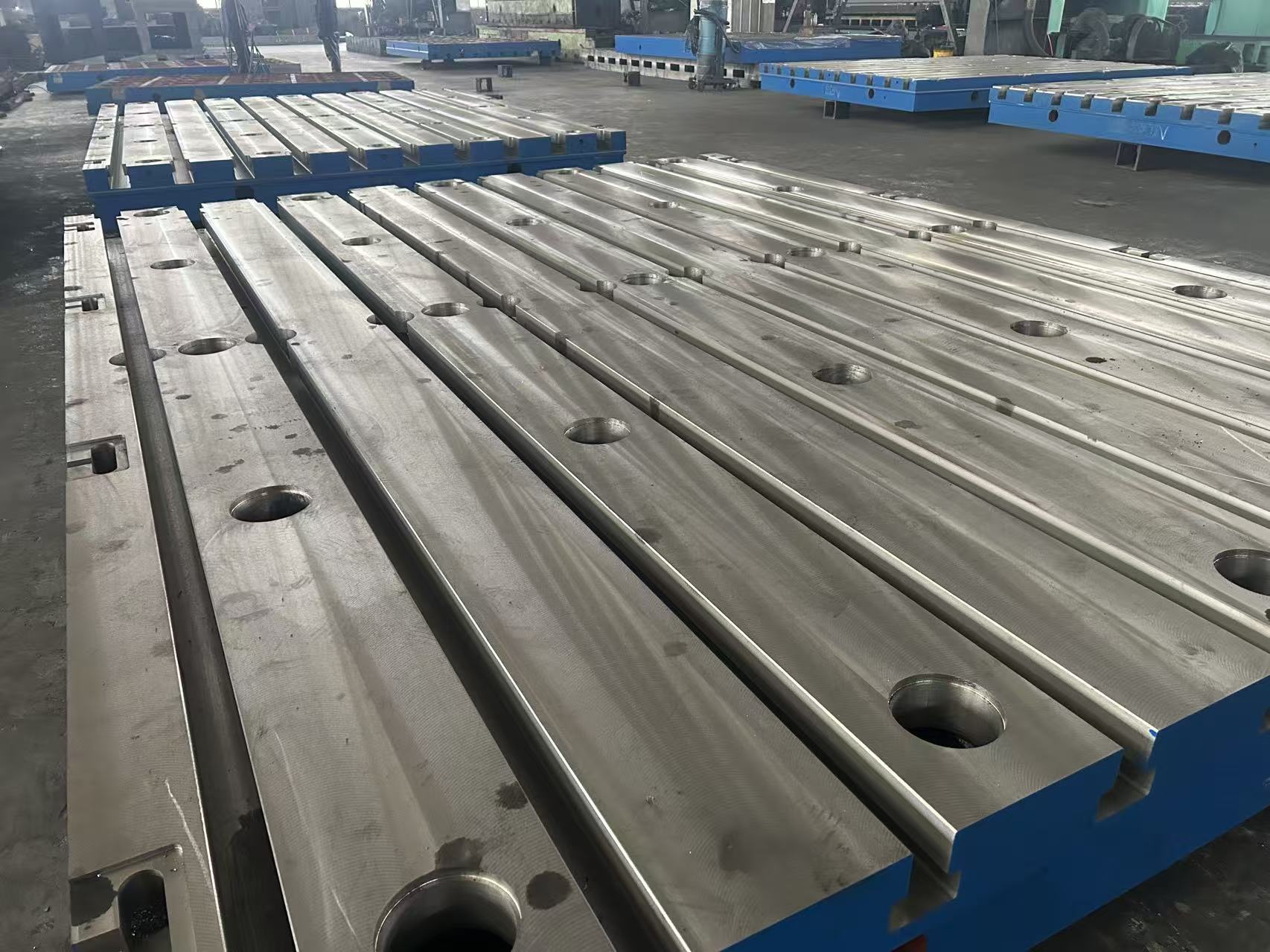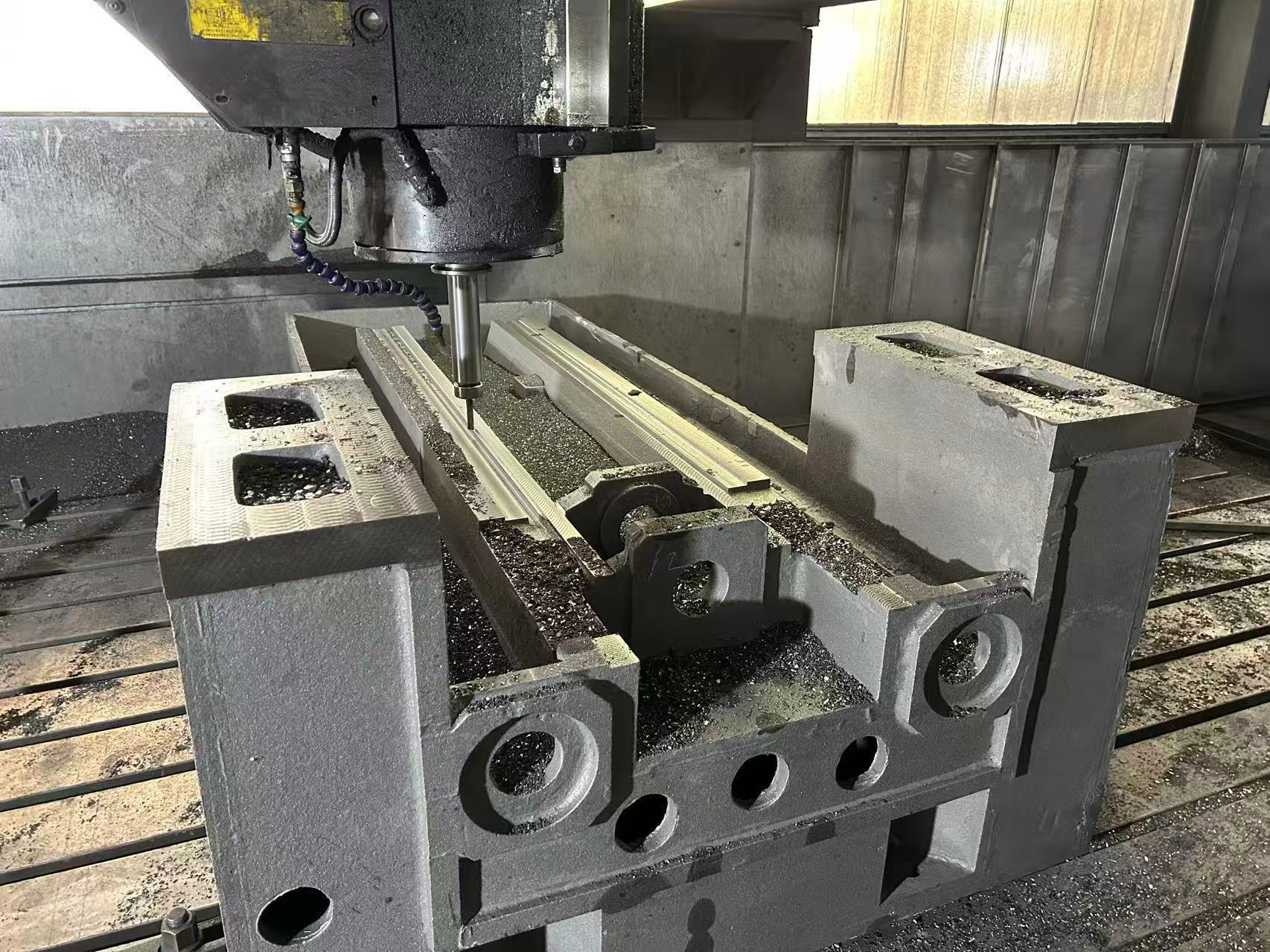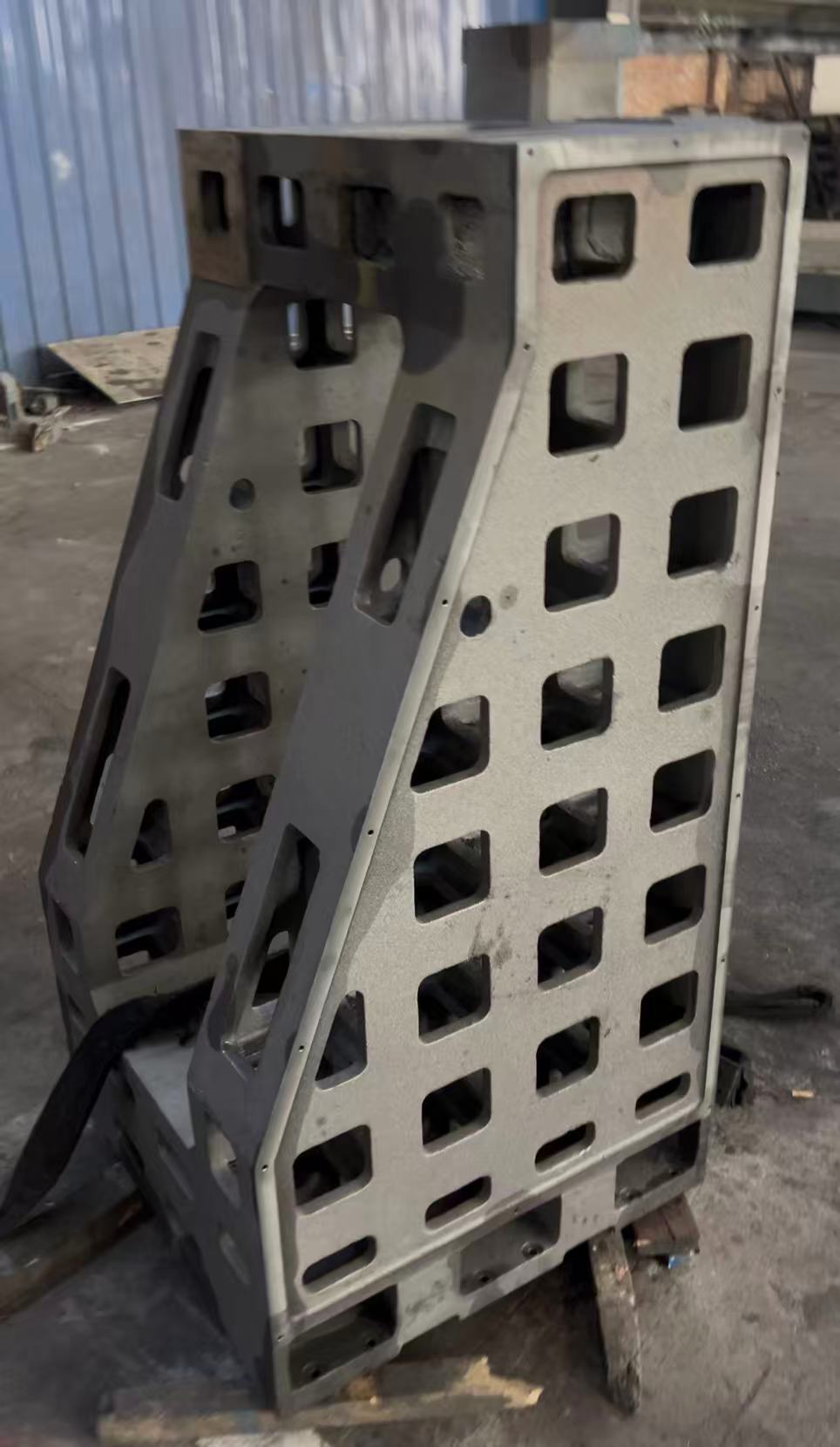
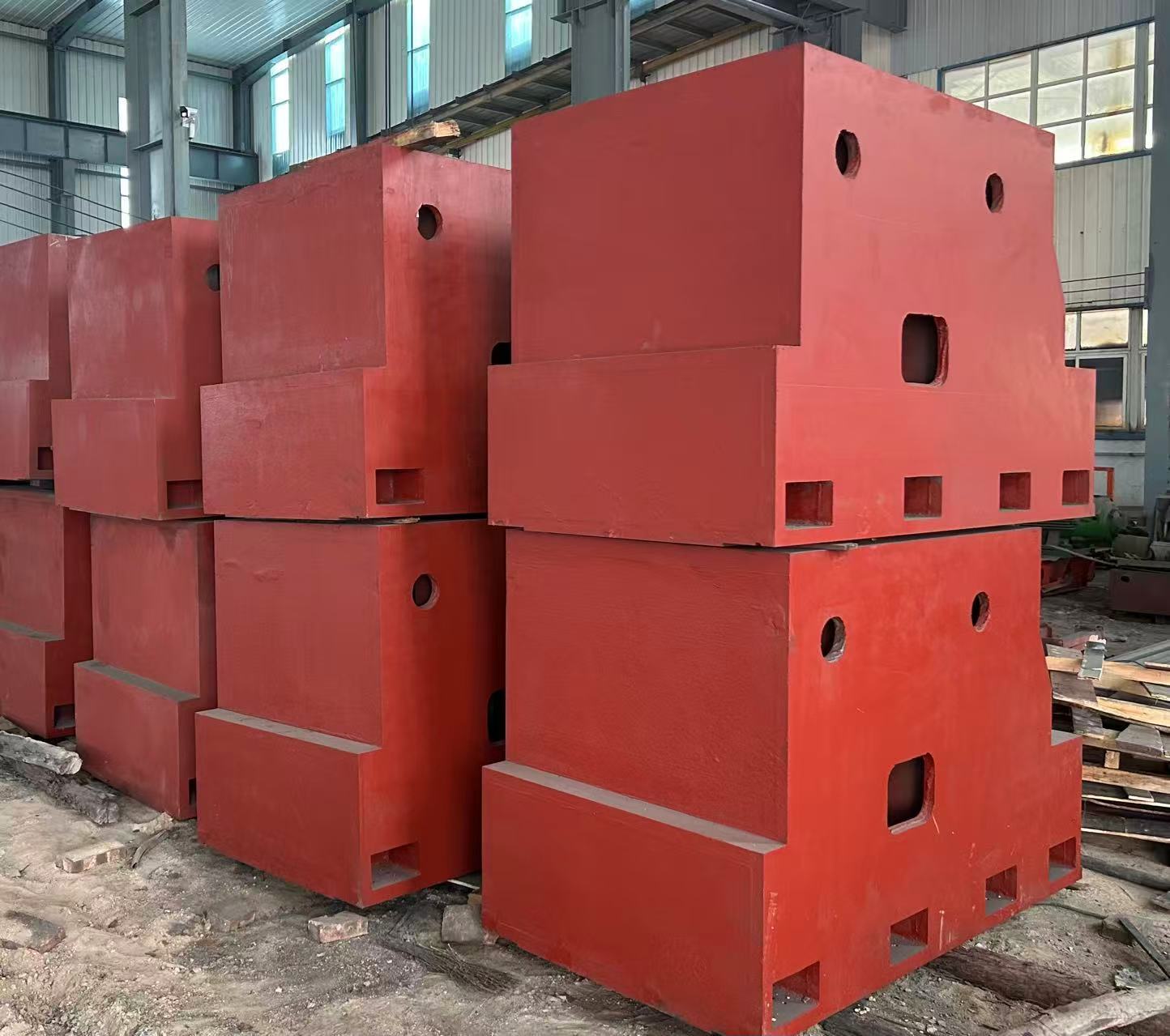
This cast iron machine tool base and large-scale cast iron equipment foundation component is specifically designed for high-end heavy-duty equipment such as heavy-duty CNC lathes, gantry machining centers, metallurgical rolling mills, wind turbine main frames, and heavy-duty testing equipment. With “high-rigidity cast iron material + large-scale precision manufacturing + anti-deformation structural design” as the core, it overcomes the four major pain points of traditional foundation components: “insufficient load-bearing capacity leading to easy cracking, poor machining accuracy of large sizes, excessive deformation during long-term use, and difficulty in ground adaptation”.
High-strength gray cast iron (HT350/HT400) and ductile iron (QT600-3/QT700-2) are carefully selected. Through the “large-scale CNC boring and milling machine + aging strengthening” process, it achieves a maximum single-piece size of 10000×5000×1800mm, a load-bearing capacity of 50-300 tons, a flatness of ≤0.01mm/1000mm, and a long-term precision attenuation rate of ≤0.08% per year.
It covers industries such as heavy machinery manufacturing, metallurgy, wind power, and aerospace. It helps to increase the machining accuracy of heavy-duty equipment by 25%, extend the service life by 3 times, and reduce the installation and commissioning cost of large-scale equipment by 30%.
◦ HT350/HT400 灰色鋳鉄:鋳鉄製工作機械台座の主要材料。引張強度はHT350で350MPa以上、HT400で400MPa以上であり、硬度は200~260HBです。最適化されたフレーク状黒鉛の分布により衝撃吸収性が向上し(衝撃吸収係数は鋼材の4~6倍)、重量切削工作機械の主軸回転(10,000~15,000rpm)によって生じる高周波振動を効果的に吸収し、加工時の振動痕の発生を防止します。単体重量80トン以下、サイズ6,000×4,000mm以下の工作機械台座(例えば大型CNC旋盤台や門形フライス盤台など)に適しています。
◦ QT600-3/QT700-2 Ductile Iron: The core material for large-scale equipment foundation components (such as rolling mill foundation bases and wind turbine main frame foundations). It has a tensile strength of ≥600MPa (for QT600-3) / 700MPa (for QT700-2) and an elongation of ≥3%. Its toughness is 3-4 times that of gray cast iron, and it can withstand 300-ton-level impact loads (such as rolling force in steel rolling and operating impact of wind power equipment) to avoid cracking of foundation components. With a hardness of 220-280HB, it has both anti-fatigue and wear-resistant properties, making it suitable for scenarios with strong impact and high load.
◦ Process Guarantee for Large-Scale Foundation Components: The “resin sand negative pressure molding + lost foam casting” composite process (for complex large-scale parts) is adopted to reduce air holes and shrinkage defects in large-scale castings (defect rate ≤0.3%). After 90-120 days of natural aging (50% longer than conventional castings) + 3 times of artificial aging treatment (holding at 550-600℃ for 8 hours), more than 99.5% of internal stress is eliminated, avoiding long-term deformation of large-scale foundation components due to stress concentration (deformation ≤0.1mm/m in 10 years), which is far better than that of welded structure foundation components (deformation ≥0.5mm/m in 5 years).
To address the problem of “thermal deformation sensitivity” of large-scale foundation components, through “gradient wall thickness design” (the wall thickness of key load-bearing parts is 80-150mm, and that of non-load-bearing parts is 50-80mm) and “integrated heat dissipation ribs”, the thermal deformation of a 10m-long foundation component is controlled within ≤0.005mm/m (with an ambient temperature fluctuation of ±10℃). The surface adopts a three-layer protection of “sandblasting derusting + epoxy primer + wear-resistant topcoat”, which can pass a salt spray test of ≥720 hours. It is suitable for the high-temperature (≤150℃) and high-dust environment of metallurgical workshops and the cutting fluid erosion environment of machine tool workshops, avoiding the impact of foundation component rust on stability.
◦ Cast Iron Machine Tool Bases: The “box-type main structure + cross-shaped reinforcing ribs” design is adopted (rib spacing 300-500mm). For example, a 6000×3000×800mm heavy-duty CNC lathe base has a 60% increase in bending stiffness. When bearing the weight of a 50-ton workpiece + spindle box for a long time, the deformation is ≤0.003mm/m, avoiding the parallelism deviation between the spindle and the guideway during machine tool machining (deviation ≤0.002mm/1000mm).
◦ Large-Scale Equipment Foundation Components: For ultra-load scenarios such as rolling mills and wind power equipment, the “box-type structure + honeycomb dense ribs” design is adopted (rib spacing 200-300mm). For example, an 8000×4000×1500mm rolling mill foundation base has a compressive strength of ≥200MPa. When bearing the entire 200-ton rolling mill, the settlement of the foundation component is ≤0.005mm, ensuring the stable reference of the equipment during the rolling process.
The “large-scale CNC boring and milling machine (stroke 12000×5000×2000mm) + large-scale surface grinding machine” composite machining is adopted to achieve:
◦ 工作機械台座の取付面:平坦度≤0.01mm/1000mm、ガイドウェイ取付面の直線度≤0.008mm/1000mm、孔系統(φ50~φ200mmの位置決め穴)の位置許容差±0.015mm。工作機械のガイドウェイや主軸箱の精密設置に適しており、組立時の基準調整時間を大幅に短縮します。
◦ 大型設備基礎部材の接合面:設備設置面の平面度は≤0.015mm/1000mm、アンカーボルト穴(φ80~φ150mm)の位置許容差は±0.02mmであり、現場での精密な水平調整を容易にし、圧延機や風力発電機の主フレームなどの大型設備の固定据付に対応できるよう、設備レベリング用の穴(間隔1000~2000mm)を設けています。
For ultra-large-scale foundation components with a length of ≥10m (such as the foundation of a 12m-long large coordinate measuring machine), the “block casting + on-site splicing” technology is adopted: the splicing surfaces are processed with spigots (tolerance H7/h6) to ensure that the vertical/horizontal misalignment is ≤0.005mm; M40-M60 high-strength splicing bolts (tensile strength ≥Grade 12.9) are matched, and the overall flatness after splicing is ≤0.015mm/1000mm. The overall load-bearing capacity does not decrease (the load-bearing strength at the splicing joint is ≥95% of the main body), solving the pain point that traditional large-scale foundation components “cannot be transported due to integral casting”.
◦ 埋め込み設置:大型基礎部材(例えば圧延機の基礎台など)を地盤コンクリート(コンクリート強度≥C30)に埋め込み、埋め込み用鉄筋で基礎部材と接続することで全体の安定性を向上させます。長期間固定される重荷重設備に適しています。
◦ 地面固定設置:鋳鉄製工作機械ベースをアンカーボルト(M30~M50)で地面に固定し、底部には耐荷重≤50トン/セット、調整範囲0~20mm、水平精度±0.001mm/mの高精度調整パッド鉄板を組み合わせることで、後からの精密調整が容易になり、工作機械設備の定期的な校正ニーズに対応します。
◦ Shock Absorption Installation: For vibration-sensitive equipment (such as the foundation of precision testing machines), air spring shock absorption modules (shock absorption efficiency ≥90%) are installed at the bottom of the foundation components to isolate ground vibrations (such as the operation of other equipment in the workshop) and ensure the operating accuracy of the equipment (detection repeatability error ≤0.003mm).
◦ 重荷重CNC旋盤用基礎:HT400材質、寸法6000×3000×800mm、耐荷重≤80トン、ガイドウェイ取付面の直角度≤0.008mm/1000mm。φ2000mmの風力発電主軸や船舶用クランクシャフトの加工に適しています。
◦ 圧延機基礎台:QT600-3材質、寸法8000×4000×1500mm、耐荷重≤200トン、取付面の平坦度≤0.015mm/1000mm。冶金用熱間・冷間圧延機に適しており、圧延厚さの公差±0.03mmを保証します。
◦ 風力タービン主フレーム基礎:QT700-2材質、寸法5000×5000×1200mm、耐荷重≤300トン、衝撃荷重耐性≥500kN。3~10MW級風力タービン主フレームの据付に適し、風力発電設備の長期安定稼働(耐用年数20年)を確保します。
基礎部材には、設備冷却水回路(穴径30~50mm、流量≥20L/min)および油圧配管インターフェース(φ20~φ40mm)を備え、圧延機の潤滑システムや工作機械主軸の冷却システムに対応しています。また、センサー取付用穴(φ8~φ15mm)も設けられており、振動監視や温度監視システムと接続することで、基礎部材の稼働状態をリアルタイムでモニタリングし、変形リスクを早期に警告(変形が0.01mmを超えた場合に自動警報)することが可能です。
| コンポーネントカテゴリ | コアパラメータと構成(大型基礎部品の高度な特性) |
| 鋳鉄製工作機械ベース | 材料:HT350/HT400 灰鋳鉄;サイズ:単体ブロック ≤6000×4000×1000mm、継ぎ合わせ ≤10000×5000×1200mm;精度:取付面の平面度 ≤0.01mm/1000mm、ガイドウェイ面の直線度 ≤0.008mm/1000mm;耐荷重:50~80トン;構造:箱型+クロスリブ、ガイドウェイ取付溝・冷却水回路・センサー用穴を備える |
| 大型鋳鉄製設備基礎部品 | 材料:ダクタイル鋳鉄 QT600-3/QT700-2;サイズ:一体構造時 ≤8000×4000×1500mm、継ぎ合わせ構造時 ≤15000×6000×2000mm;精度:取付面の平面度 ≤0.015mm/1000mm、穴位置許容差 ±0.02mm;耐荷重:100~300トン;構造:箱型+ハニカム補強筋、アンカー穴・レベリング穴および衝撃吸収用取付溝を備える |
| 補助部品 | Heavy-duty adjustment pad irons (load-bearing ≤50 tons/set, adjustment range 0-20mm); High-strength splicing bolts (M40-M60, Grade 12.9); Air spring shock absorption modules (shock absorption efficiency ≥90%, load-bearing ≤100 tons/set); Large-scale levels (accuracy 0.01mm/m, used for installation and leveling) |
| 設置用アクセサリー | 埋設用鋼棒(φ20~φ30mm、埋め込み施工に適す);拡張ボルト(M30~M50、地盤固定に使用);シーリングゴムストリップ(継ぎ手部の防塵・防液浸入用シーリングに適す) |