
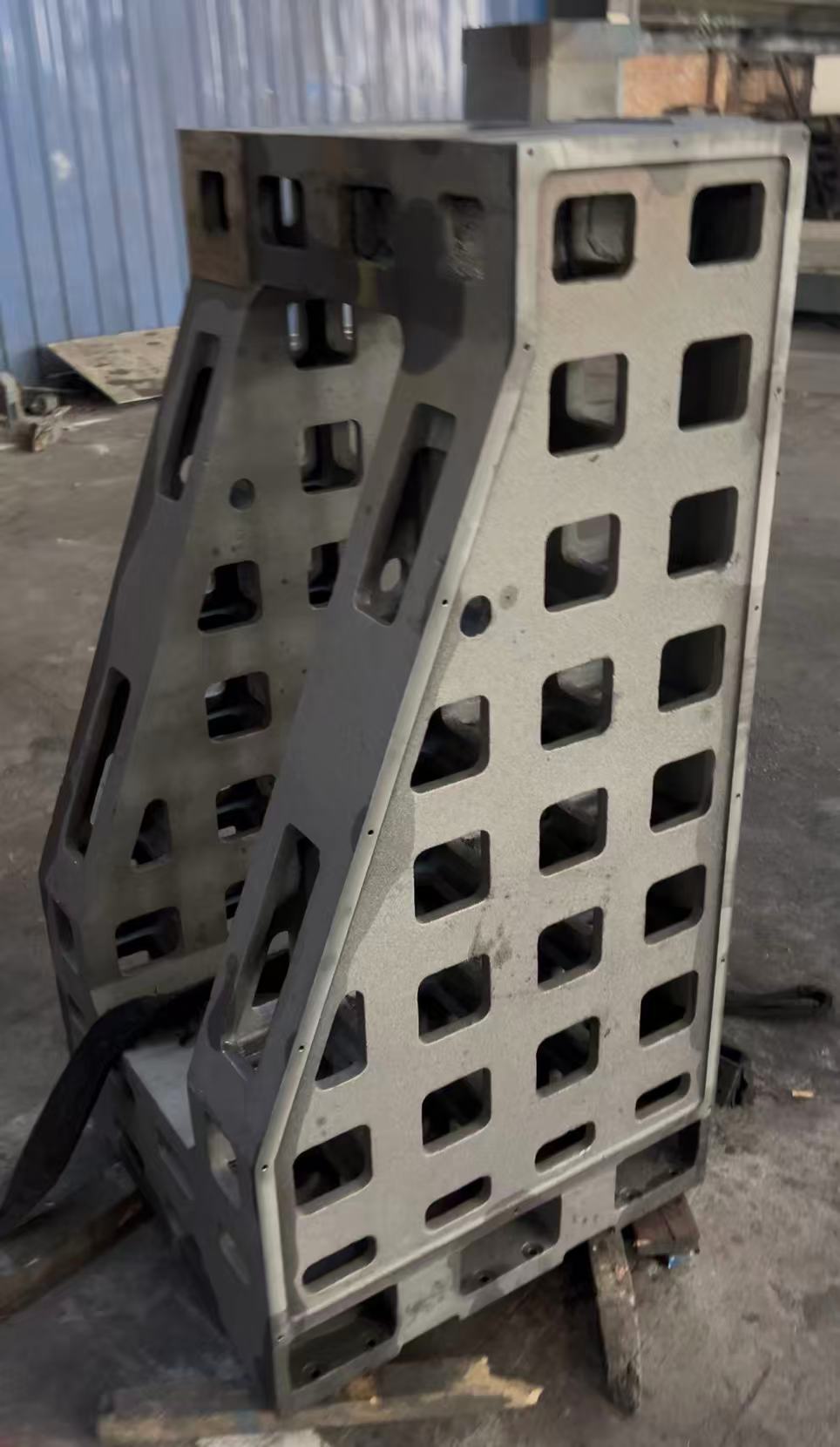
This cast iron machine tool column and large-scale industrial equipment support frame is specifically designed for vertical machining centers, gantry milling machines, CNC boring machines, metallurgical rolling mills, wind turbine main frames, and other equipment. With “vertical precision control + ultra-load-bearing support + cast iron material enhancement” as the core, it overcomes the four major pain points of traditional support structures: “rapid vertical precision attenuation, insufficient load-bearing leading to easy bending, poor vibration resistance affecting equipment performance, and difficulty in installing large-scale frames”.
High-quality materials are carefully selected, including QT500-7/QT600-3 ductile iron (the main material for machine tool columns), HT350-HT400 gray cast iron (for conventional support), and QT700-2 ductile iron (for ultra-heavy-duty frames). Through processes such as “CNC milling + guideway precision grinding + ultra-long aging treatment”, the verticality of machine tool columns is ≤0.002mm/m, the straightness of guideways is ≤0.003mm/m, the load-bearing capacity of large-scale support frames is 50-200 tons, the vertical settlement is ≤0.005mm per year, and the long-term precision attenuation rate of the entire structure is ≤0.05% per year.
It covers industries such as machine tool manufacturing, metallurgy, wind power, and heavy machinery. It helps to increase the movement precision of machine tool spindle boxes by 40%, improve the operational stability of large-scale equipment by 60%, and shorten the installation and commissioning cycle by 35%.
◦ Machine Tool Columns (QT500-7/QT600-3 Ductile Iron): The tensile strength is ≥500MPa (for QT500-7) / 600MPa (for QT600-3), the bending strength is ≥700MPa / 800MPa, and it has excellent fatigue resistance (capable of withstanding 10⁶ times of impact from the up-and-down movement of the spindle box). The vertical deformation is ≤0.001mm/m (when bearing 30 tons). The guideway surface can be optionally quenched (hardness 50-55HRC), which doubles the wear resistance, making it suitable for scenarios requiring high-precision guidance such as vertical machining centers and CNC boring machines.
◦ Large-Scale Industrial Equipment Support Frames (HT400/QT600-3/QT700-2): For conventional vertical load-bearing (50-100 tons), HT400 is selected (its shock absorption coefficient is 3-5 times that of steel, absorbing equipment vibration). For heavy-duty load-bearing (100-150 tons), QT600-3 is chosen. For ultra-heavy-duty (150-200 tons, such as rolling mill housings and wind turbine main frames), QT700-2 is adopted (with a tensile strength of ≥700MPa and an elongation of ≥2%). The frame material must have the ability to resist wind loads and temperature deformation, and anti-corrosion coating treatment can be selected for outdoor scenarios (wind power).
◦ Machine Tool Columns: The “integral casting” method is adopted (to avoid vertical deviation caused by splicing). The “resin sand molding + step pouring” process is used to reduce internal defects (defect rate ≤0.3%). After 90-120 days of natural aging + 2 times of artificial aging (holding at 550-600℃ for 8 hours), more than 99.5% of internal stress is eliminated, preventing the column from “lateral bending” due to stress release during long-term use (vertical precision attenuation ≤0.01mm/m in 10 years). The guideway surface undergoes “rough milling – semi-finish milling – finish milling – grinding”, with a straightness of ≤0.003mm/m and a surface roughness of Ra≤0.8μm.
◦ Large-Scale Support Frames: For ultra-large-scale frames (height ≥5m), the “block casting + on-site splicing” method is used. The splicing surfaces are provided with spigot positioning (tolerance H7/h6), and high-strength bolts (M40-M60, Grade 12.9) are used. The verticality after splicing is ≤0.008mm/m. The installation surface undergoes “finish milling – lapping”, with a flatness of ≤0.01mm/1000mm, ensuring the positioning accuracy with the top/bottom of the equipment.
◦ Rectangular Guideways: Suitable for heavy-duty spindle boxes (weight ≤30 tons), the width of the guideway surface is 80-200mm, the verticality is ≤0.002mm/m, the contact area with the slider is ≥90%, and the up-and-down movement precision of the spindle box is ≤0.002mm/1000mm (such as the Z-axis of vertical machining centers).
◦ Dovetail Guideways: Compact structure (suitable for small and medium-sized columns), the dovetail angle is 55°/60°, the gap can be fine-tuned through inserts, the guidance precision is ≤0.003mm/m, and it is suitable for space-constrained scenarios (such as CNC boring machine columns).
◦ Double Guideway Symmetrical Layout: Large gantry milling machine columns (height ≥3m) adopt a “double rectangular guideway symmetrical design” with a spacing of 200-500mm. The anti-overturning moment is increased by 80%, preventing the column from “unilateral stress bending” when the spindle box moves, and ensuring the beam movement precision is ≤0.005mm/2000mm.
◦ The periphery of the guideway surface adopts “local thickening + quenching” (quenching depth 2-5mm) to improve the local compressive strength (≥250MPa), preventing guideway depression caused by long-term stress (service life ≥100,000 hours).
◦ The side of the column reserves a grating scale installation groove (width 15-30mm, depth 5-10mm) and a spindle cooling water channel (aperture 15-25mm), adapting to precision feedback and heat dissipation needs without secondary processing, reducing assembly errors.
◦ Conventional Support Frames (height 3-5m): Adopt a “box-type main structure + cross-shaped reinforcing ribs” (rib spacing 200-300mm). For example, a rolling mill support frame (size 3000×2000×5000mm) has a deformation of ≤0.003mm/m when vertically bearing 100 tons, and the bending stiffness is increased by 70%.
◦ Ultra-Heavy-Duty Frames (such as wind turbine main frame supports, height ≥8m): Adopt a “box-type structure + honeycomb-shaped dense ribs” (rib spacing 150-200mm). When vertically bearing 200 tons, the settlement is ≤0.005mm per year, and it also has the ability to resist wind loads (wind pressure ≤0.7kPa) and earthquakes (seismic intensity ≤8 degrees).
◦ Embedded Installation: Metallurgical rolling mill support frames are embedded into the ground concrete (C30 or above) through anchor bolts (M50-M80, Grade 12.9), and anti-pull anchor bars are set at the bottom to enhance vertical load-bearing stability and prevent the frame from “floating” (anti-pull force ≥500kN).
◦ Adjustable Installation: The bottom of wind power equipment support frames is equipped with heavy-duty leveling pad irons (adjustment range 0-30mm, load-bearing ≤50 tons per set), which can cope with outdoor ground unevenness (horizontal error ≤0.1%), and the verticality after leveling is ≤0.008mm/m.
◦ Top Positioning Adaptation: The top of the frame is provided with equipment installation positioning holes (tolerance H7) and sealing grooves, adapting to the precise fixing of rolling mill housings and wind turbine main frames. The positioning error is ≤0.005mm, ensuring the vertical alignment of the equipment (coaxiality ≤0.01mm/1000mm).
| Component Category | Core Parameters and Configuration (Vertical Feature Enhancement) |
| Cast Iron Machine Tool Columns | Material: QT500-7/QT600-3 ductile iron; Size: Height 1500-5000mm, Cross-section 500×500mm-1000×1000mm (width × thickness); Precision: Verticality ≤0.002mm/m, Guideway straightness ≤0.003mm/m, Surface Ra≤0.8μm; Structure: Rectangular/dovetail guideways, grating scale grooves, cooling water channels; Load-bearing: Vertical load-bearing 10-50 tons, Spindle box movement speed ≤10m/min |
| Large-Scale Industrial Equipment Support Frames | Material: HT400/QT600-3/QT700-2; Size: Height 3000-10000mm, Cross-section 1000×1000mm-2000×2000mm; Precision: Verticality ≤0.008mm/m, Installation surface flatness ≤0.01mm/1000mm; Structure: Box-type + cross/honeycomb ribs, anchor holes, top positioning holes; Load-bearing: Vertical load-bearing 50-200 tons, Wind load resistance ≤0.7kPa |
| Auxiliary Accessories | Heavy-duty leveling pad irons (adjustment range 0-30mm, load-bearing ≤50 tons per set); Guideway inserts (wear-resistant cast iron material, suitable for gap adjustment); Anti-corrosion coatings (for outdoor scenarios, salt spray resistance ≥720 hours); High-strength splicing bolts (M40-M60, Grade 12.9, suitable for large-scale frame splicing) |
◦ Machine Tool Columns: Height 1500-5000mm, cross-section 500×500mm-1000×1000mm, guideway type (rectangular/dovetail), precision level (conventional ≤0.003mm/m, precision ≤0.002mm/m).
◦ Large-Scale Frames: Height 3000-10000mm, cross-section 1000×1000mm-2000×2000mm, load-bearing 50-200 tons, installation method (embedded/adjustable), environmental adaptation (outdoor/indoor).
◦ Material Selection: QT500-7/QT600-3 for machine tool columns, HT400/QT600-3 for conventional frames, QT700-2 for ultra-heavy-duty frames;
◦ Process Enhancement: Guideway quenching (hardness 50-55HRC), ultra-long aging (120 days, for precision scenarios), outdoor anti-corrosion coatings (fluorocarbon paint/galvanizing).
◦ Installation and commissioning (precision ±0.001mm/m), leveling pad iron installation, splicing guidance (for large-scale frames), and provision of installation reports;


Hebei Yuanzhu Machinery Manufacturing Co., Ltd.