
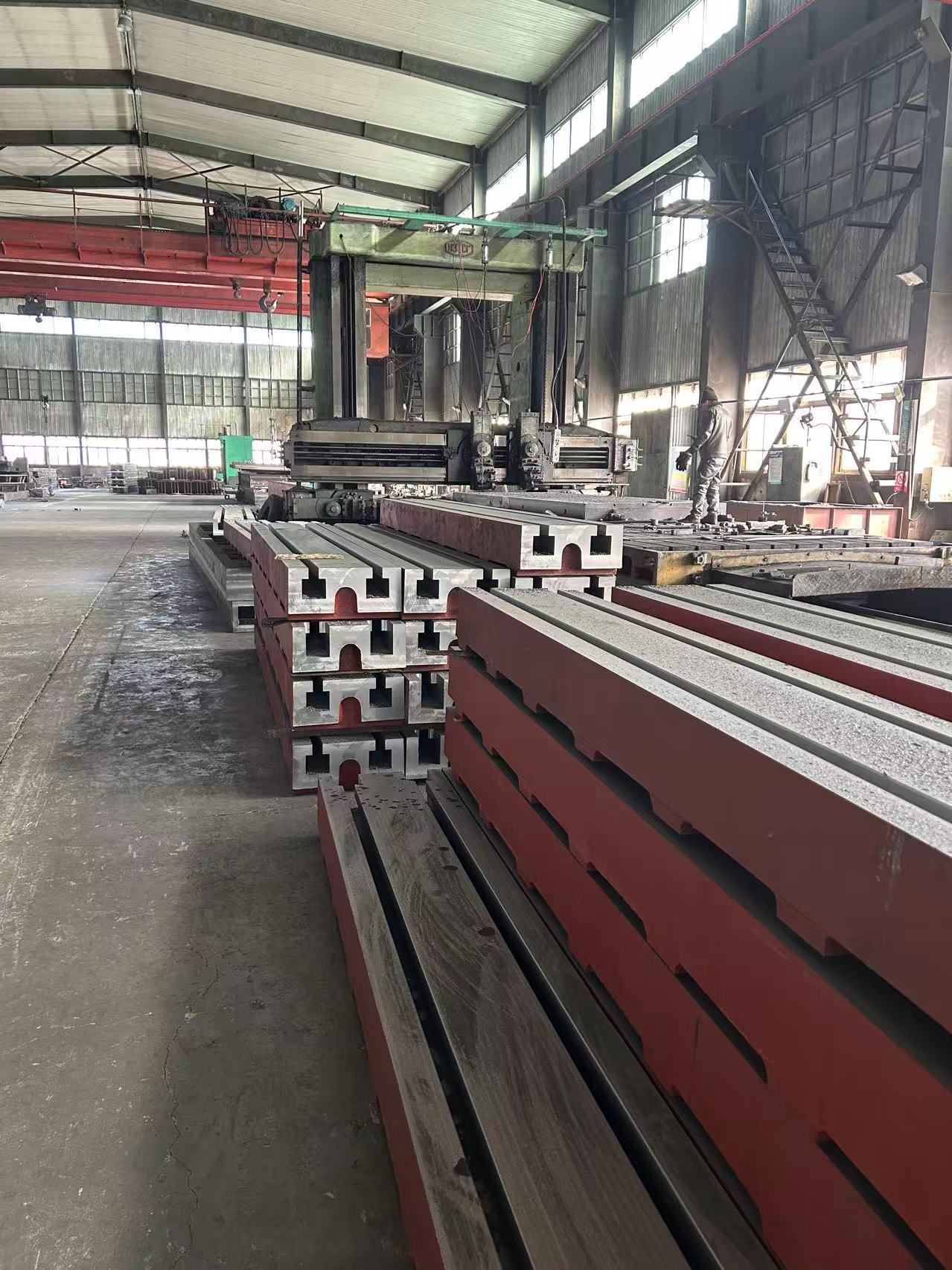
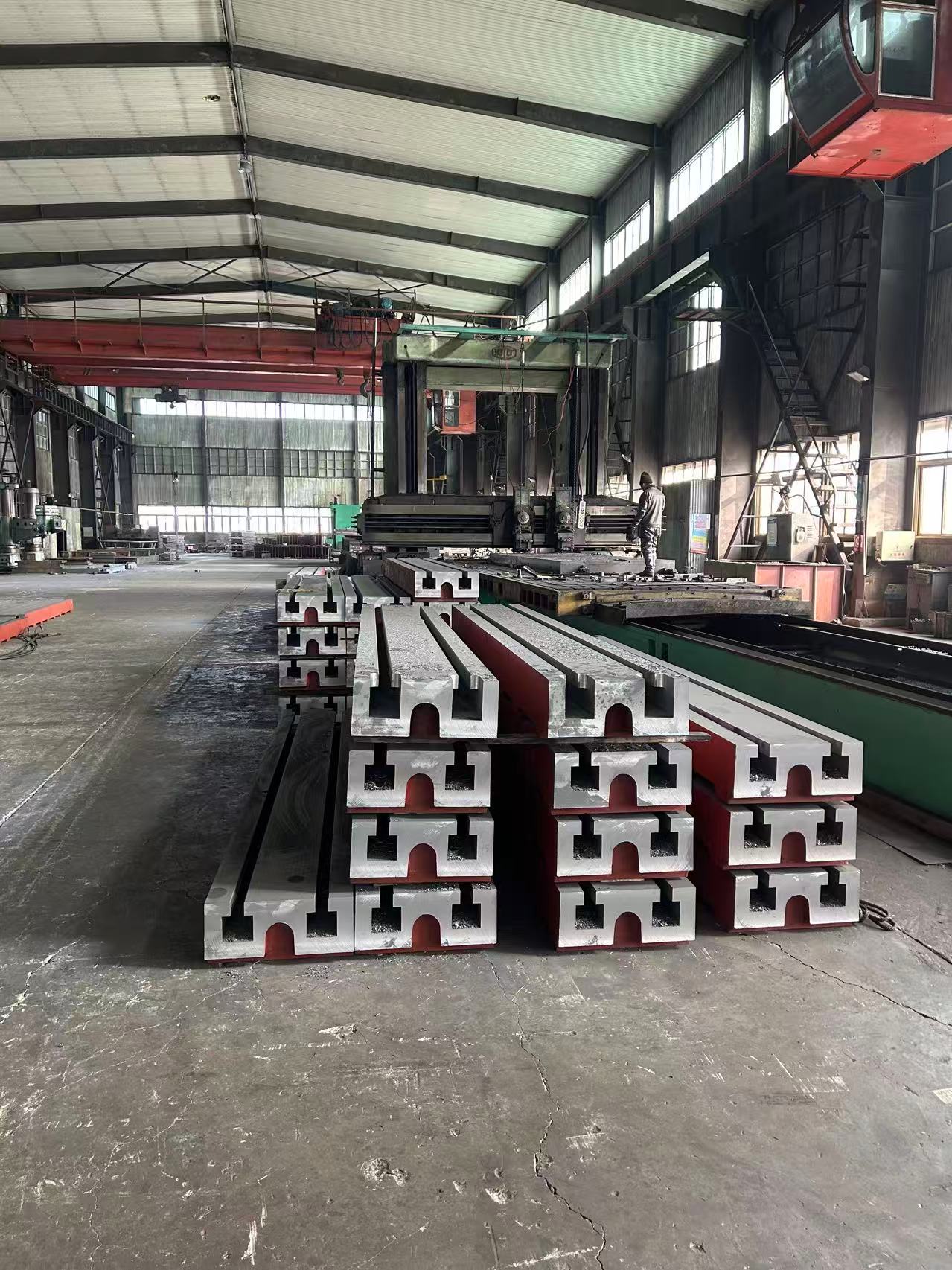
This cast iron ground rail (including cast iron T-slots and cast iron guide rails) is specifically designed for linear movement of heavy-duty equipment, ground datum positioning, large workpiece inspection, and production line integration. With “high-rigidity cast iron material + linear precision machining + ground-adaptable structure” as the core, it overcomes the three major pain points of traditional ground rails: “insufficient load-bearing capacity leading to easy deformation, poor splicing accuracy, and difficulty in leveling during ground installation”.
High-quality materials are carefully selected, including HT300/HT350 high-strength gray cast iron and QT500-7 ductile iron. Through precision machining by “CNC lathes + milling machines”, the straightness of a single ground rail is ≤0.005mm/m, the splicing error is ≤0.008mm/m, and the load-bearing capacity of a single rail is 10-50 tons. It is suitable for scenarios such as linear movement of heavy-duty machine tools, installation datum of rolling mill equipment, and heavy-duty transportation rails in logistics.
It covers industries such as heavy machinery manufacturing, metallurgy, aerospace, and port logistics. It helps to improve the linear movement accuracy of equipment by 30%, extend the ground datum calibration cycle by 2 times, and reduce the installation cost of ground rails by 25%.
◦ HT300/HT350 Gray Cast Iron: The main material for conventional ground rails. It has a tensile strength of ≥300MPa (for HT300) / 350MPa (for HT350) and a hardness of 180-240HB. The optimized flake graphite distribution enhances shock absorption (the shock absorption coefficient is 3-4 times that of steel), which can absorb impact vibrations generated by the movement of heavy-duty equipment (such as 30-ton sliding tables) and avoid local stress concentration cracking of the rails. It is suitable for scenarios with a single rail load-bearing of ≤30 tons and no strong impact in the environment (such as machine tool linear guide rails and inspection datum rails).
◦ QT500-7 Ductile Iron: A special material for heavy-impact scenarios. It has a tensile strength of ≥500MPa and an elongation of ≥7%. Its toughness is 2-3 times that of gray cast iron, and it can withstand impact loads of 50-ton-level heavy-duty equipment (such as rolling mills and cranes). The wear resistance of the rail surface is increased by 50%. It is suitable for high-impact and high-wear scenarios such as port logistics and metallurgical rolling mills.
◦ Linear Casting and Aging Processes: The “resin sand molding + continuous pouring” process is adopted to ensure uniform linear structure of the ground rails (no local shrinkage holes or air holes, with a defect rate of ≤0.5%). After 60-90 days of natural aging + 2 times of artificial aging treatment (holding at 550-600℃ for 6 hours), more than 99% of internal stress is eliminated, avoiding linear bending of the ground rails due to stress release during long-term use (linear deformation ≤0.01mm/m in 10 years).
The surface of the ground rail undergoes a four-step processing of “rough milling – semi-finish milling – finish milling – grinding”: after finish milling, the straightness of the rail working surface (such as the top surface and side surface) is ≤0.005mm/m, and the surface roughness is Ra≤1.6μm. For high-precision scenarios (such as machine tool linear guide rails), additional quenching treatment is performed on the rail surface (hardness increased to 50-55HRC), which doubles the wear resistance. After long-term use (≥100,000 equipment movements), the wear amount of the rail surface is ≤0.002mm, and frequent regrinding is not required.
Exclusive cross-sectional shapes are designed for different scenarios to cover mainstream application needs:
◦ Rectangular Ground Rails: The top surface is a flat load-bearing surface (width 50-200mm), suitable for fixed installation of heavy-duty equipment (such as rolling mill bases and large inspection machines). After ground installation, the flatness is ≤0.01mm/m, serving as the linear datum of the equipment.
◦ T-Slot Cast Iron Rails: The side surface is provided with T-slots (slot width 20-50mm, tolerance H8), which can fix the equipment sliding table through T-bolts. It is suitable for linear movement of equipment (such as heavy-duty machine tool sliding tables and logistics transportation trolleys), and the movement accuracy of the sliding table is ≤0.008mm/m.
◦ Grooved Guide Rails: The cross-section is U-shaped (groove depth 30-100mm), with built-in wear-resistant sliders. It is suitable for scenarios with a lot of dust (such as metallurgical workshops). The fitting gap between the slider and the rail is ≤0.003mm, avoiding dust affecting the movement accuracy.
The conventional length of a single ground rail is 1-6m (the maximum customizable length is 8m). For ultra-long linear requirements (such as 20m production line rails), the “spigot positioning + high-strength bolt fastening” splicing technology is adopted: spigots are processed on the splicing surfaces (tolerance H7/h6) to ensure that the vertical/horizontal misalignment is ≤0.005mm; M20-M30 high-strength splicing bolts (tensile strength ≥Grade 10.9) are matched, and the overall straightness after splicing is ≤0.01mm/m (the straightness of the total length of 20m is ≤0.2mm), solving the problem of “out-of-control accuracy” in traditional rail splicing.
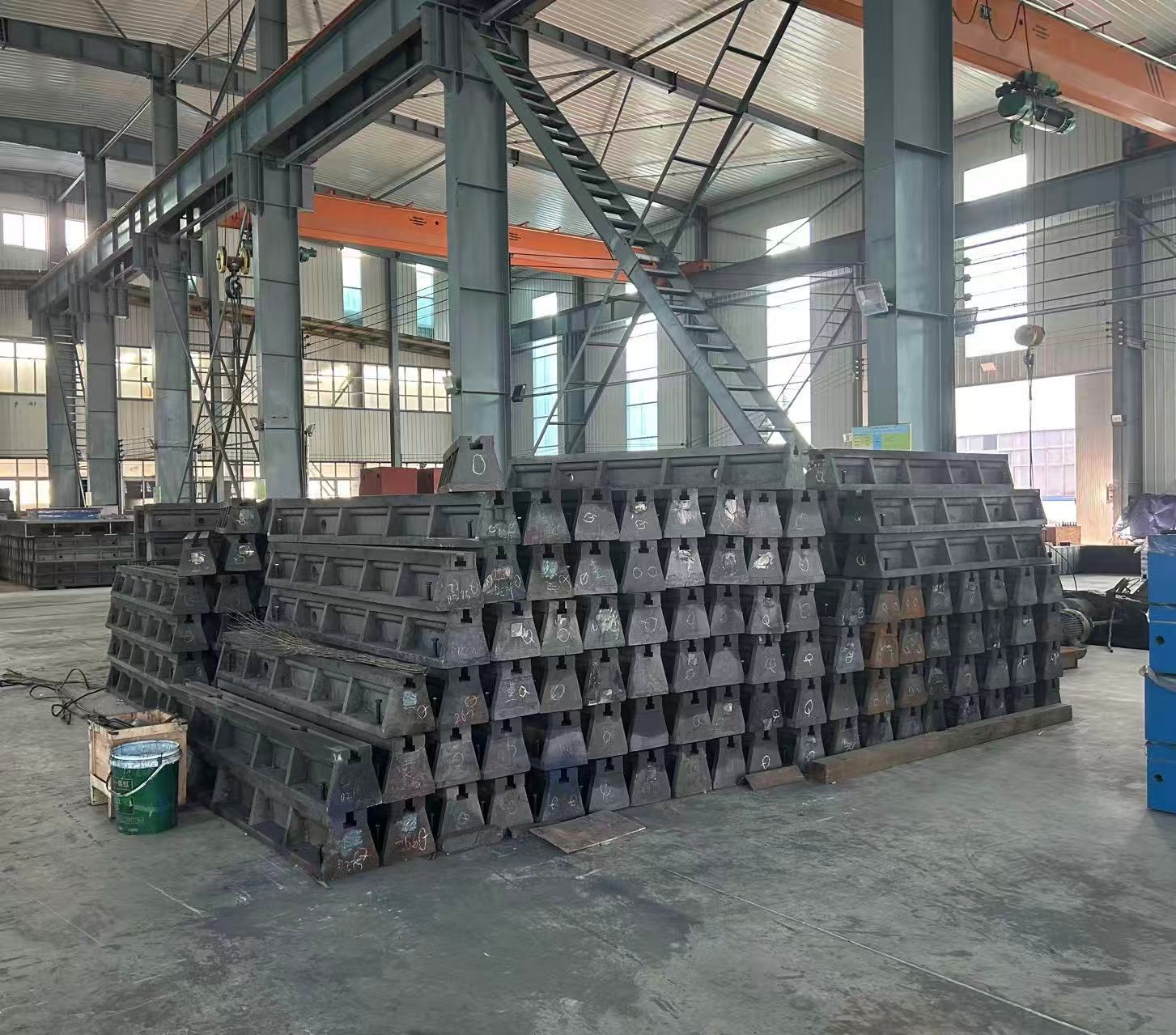
Adjustment holes (spacing 500-1000mm, hole diameter 16-24mm) are reserved at the bottom of the ground rail, and cast iron adjustment pad irons (adjustment range 0-15mm, horizontal accuracy ±0.001mm/m) are matched to realize horizontal leveling of a single ground rail. Two installation methods are supported: “embedded installation” (the ground rail is embedded in the ground concrete to enhance stability) and “ground fixing” (fixed by expansion bolts for easy later adjustment), adapting to different ground strengths (concrete strength ≥C30 can meet the installation requirements).
The surface of the ground rail adopts a three-layer anti-corrosion treatment of “sandblasting derusting + epoxy primer + chlorinated rubber topcoat”, which can pass a salt spray test of ≥480 hours and adapt to harsh environments such as humidity (relative humidity ≤95%), dust (such as metallurgical workshops), and cutting fluid erosion (machine tool scenarios). For high-temperature scenarios (such as around rolling mills, temperature ≤150℃), high-temperature-resistant coatings (temperature resistance ≤300℃) can be customized to avoid coating peeling affecting accuracy.
◦ Lubrication Interface: A lubricating oil circuit (hole diameter 6-10mm) is reserved on the side of the rail, which can be connected to an automatic lubrication system to inject oil into the fitting surface of the rail and the slider regularly, reducing wear (the lubrication cycle is extended to once a month).
◦ Dust Protection: It is adapted to steel plate/organ-type dust covers (length 1-6m, spliceable), which cover the working surface of the rail to avoid dust and iron chips accumulation affecting the movement accuracy, with a dust protection efficiency of ≥98%.
◦ Detection Interface: Laser interferometer calibration datum points (spacing 1m, accuracy ±0.0005mm) are reserved on the side of the rail, facilitating regular detection of linear accuracy without disassembling the equipment, and the calibration efficiency is increased by 60%.
◦ Linear Guide Rails for Heavy-Duty Machine Tools: Made of HT350 material, T-shaped cross-section (slot width 30mm), length 6m, straightness ≤0.005mm/m, suitable for 20-ton-level machine tool sliding tables. The movement accuracy of the sliding table is ≤0.008mm/m, and the cylindricity error of processing large workpieces (such as wind power flanges) is reduced by 25%.
◦ Installation Datum Rails for Rolling Mill Equipment: Made of QT500-7 material, rectangular cross-section (width 150mm), length 4m, load-bearing ≤50 tons, flatness ≤0.01mm/m after installation. Serving as the linear datum of the rolling mill housing, the thickness tolerance of rolled steel is reduced from ±0.1mm to ±0.03mm.
◦ Heavy-Duty Logistics Rails for Ports: Made of HT300 material, grooved cross-section (groove depth 80mm), length 3m, with a total straightness of ≤0.2mm after splicing into 20m. Suitable for 30-ton-level container transfer trolley rails, the movement speed of the trolley is ≤0.5m/s, and the operating noise is reduced to below 70dB.
| Component Category | Core Parameters and Configuration (Enhanced Linear Characteristics) |
| Cast Iron Ground Rail Body | Material: HT300/HT350 gray cast iron, QT500-7 ductile iron; Cross-section Type: Rectangular (width 50-200mm), T-shaped (slot width 20-50mm), Grooved (groove depth 30-100mm); Precision: Straightness ≤0.005mm/m, Surface Roughness Ra≤1.6μm (Ra≤0.8μm after quenching); Size: Single length 1-6m (customizable up to 8m), Height 50-150mm, Single weight 50-500kg; Load-bearing: 10-50 tons/rail (HT300≤30 tons, QT500-7≤50 tons) |
| Auxiliary Components | Cast Iron Adjustment Pad Irons (adjustment range 0-15mm, horizontal accuracy ±0.001mm/m, load-bearing ≤10 tons/piece); High-Strength Splicing Bolts (M20-M30, Grade 10.9, suitable for multi-segment splicing); Dust Covers (steel plate/organ type, length 1-6m, dust protection efficiency ≥98%); Automatic Lubrication Joints (adapted to lubricating oil circuits, interface G1/4) |
| Installation Accessories | Expansion Bolts (M16-M24, used for ground fixing); Embedded Steel Plates (thickness 10-20mm, enhancing ground adhesion); Laser Calibration Targets (adapted to laser interferometers, accuracy ±0.0005mm) |
◦ Cross-Section Customization: Rectangular (width 50-200mm), T-shaped (slot width 20-50mm), grooved (groove depth 30-100mm); special cross-sections can be designed according to equipment drawings;
◦ Length and Precision: Single length 1-8m; conventional precision (straightness ≤0.008mm/m), precision grade (≤0.005mm/m), ultra-precision grade (≤0.003mm/m, requiring grinding processing).
◦ Material Selection: HT300 for conventional scenarios, HT350 for high-precision scenarios, QT500-7 for strong-impact scenarios;
◦ Process Enhancement: Rail surface quenching (hardness 50-55HRC, for high-wear scenarios), ultra-long time aging (90 days, for high-precision scenarios), high-temperature-resistant coatings (≤300℃, for high-temperature environments).
◦ After-Sales Guarantee: 1-year free warranty (including rail wear repair), lifelong technical support, regular (1-2 years) on-site linear accuracy detection and maintenance;
◦ Batch Services: Exclusive production lines are provided for batch orders (≥20 rails) to shorten the delivery cycle (50-60 days for conventional orders, 45-50 days for emergency orders).


Hebei Yuanzhu Machinery Manufacturing Co., Ltd.