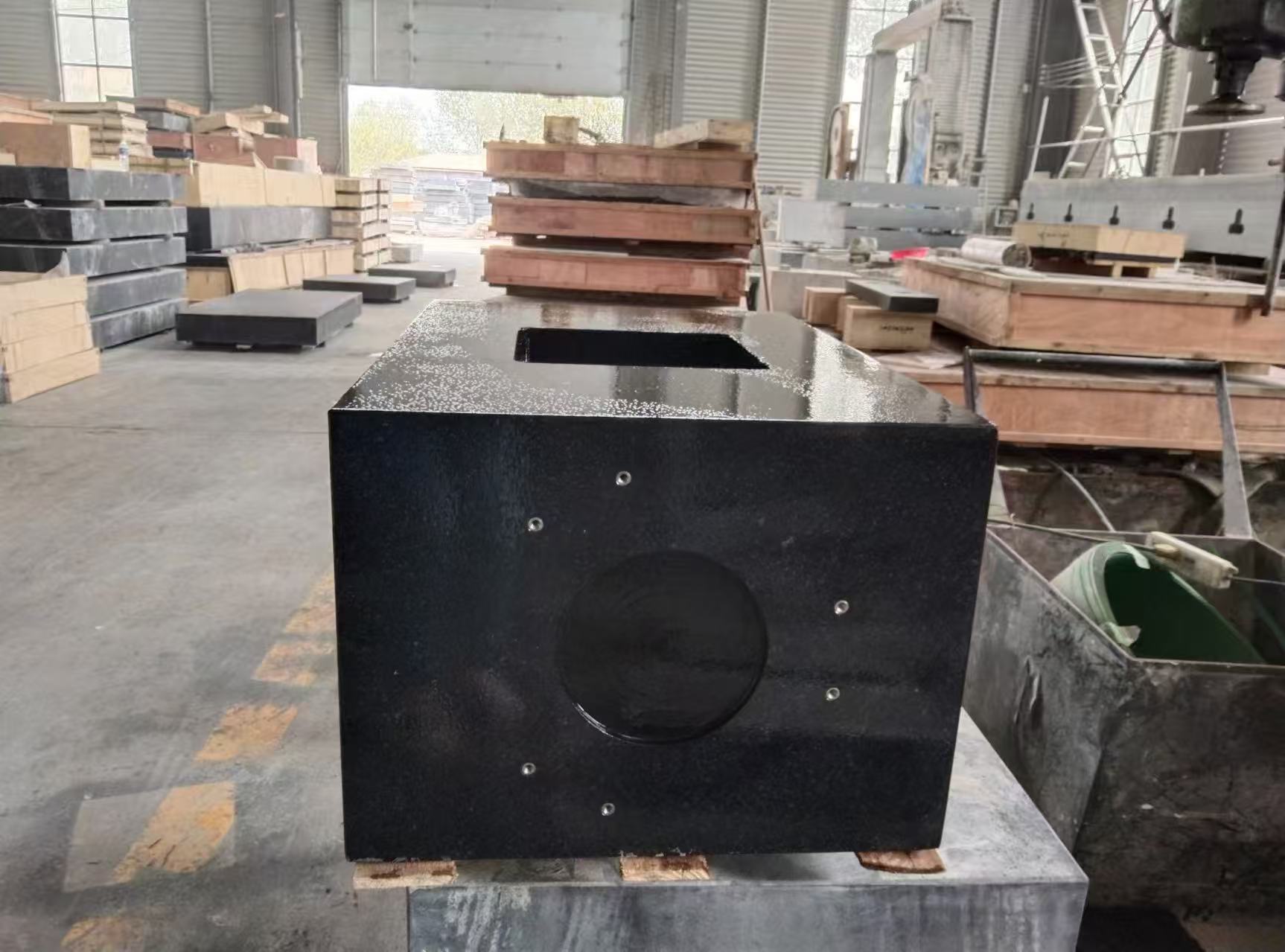
Solution Overview
Tailored to the core structural needs of high-end equipment, this granite precision mechanical component is specifically designed for machine tool bases (5-axis machining centers, ultra-precision grinders, large CNC lathes) and precision instrument main structural parts (large coordinate measuring machines/CMMs, semiconductor lithography machine structural parts, aero-engine test bench frames). With “micron-level precision datum, super-strong rigid load-bearing, and all-working-condition anti-interference” as its core, it addresses three key pain points of traditional metal components: “precision drift caused by thermal deformation, equipment performance impact from vibration transmission, and increased gaps due to long-term wear”.
Leveraging the ultra-low thermal expansion coefficient (5-8×10⁻⁶ per ℃), high damping and vibration resistance (vibration attenuation rate ≥ 90%), and uniform stress distribution of high-density granite (Jinan Green/Taishan Green), the component ensures a flatness of ≤ 0.003mm per 1000mm, straightness of ≤ 0.002mm per 1000mm, and long-term precision attenuation rate of ≤ 0.05% per year. It helps improve the machining/inspection precision of high-end equipment by 40% and extend the maintenance cycle by 3 times, making it suitable for high-end manufacturing fields such as aerospace, semiconductors, and precision molds.
Core Function System
1. Precision Datum and Super-Strong Rigid Support
- Ultra-Span Precision Control: High-density granite (quartz content ≥ 65%, density ≥ 2.7g/cm³, no visible impurities) is adopted, processed through “CNC rough milling – multi-pass fine grinding – precision lapping”. A single component achieves a flatness of ≤ 0.003mm per 1000mm and straightness of ≤ 0.002mm per 1000mm for guideway mounting surfaces. Multi-component splicing is supported (maximum spliced size: 15000×5000mm), with a step error of ≤ 0.002mm at the splicing joint — avoiding the “mid-span sagging” deformation of metal components with large spans (≥ 3m) and ensuring uniform machining precision across the full stroke of machine tools (e.g., ≤ 0.008mm precision for the 6m X-axis stroke of a 5-axis machining center).
- Super Load-Bearing and Deformation Resistance: Adopts an “integral casting + thickened wall” design (machine tool base wall thickness: 80-300mm; instrument structural part wall thickness: 50-200mm), with a compressive strength of ≥ 180MPa and flexural strength of ≥ 25MPa. A single machine tool base can bear a total weight of spindle + worktable + workpiece up to 50 tons (e.g., a large CNC lathe base bearing a 30-ton workpiece). The deformation under long-term loading is ≤ 0.001mm per meter, ensuring stable parallelism and perpendicularity between the machine tool guideway and spindle (deviation ≤ 0.002mm per 1000mm) to avoid machining dimension errors.
- Integrated Functional Design: The component surface is precisely machined with guideway mounting grooves (V-shaped/rectangular/dovetail-shaped, groove width tolerance ±0.005mm), T-slots (for worktable fixing, groove width: 12-40mm, spacing: 50-150mm), and equipment mounting spigots (tolerance H7). Precision instrument structural parts reserve anchor fixing holes (φ20-φ50mm) and inspection datum surfaces (flatness ≤ 0.003mm per 1000mm), enabling direct adaptation to core component installation without secondary processing — reducing precision loss caused by intermediate connectors.
2. Stable Operation with Anti-Interference Under All Working Conditions
- Ultra-Low Thermal Deformation Suppression: The thermal expansion coefficient of granite is only 1/2 that of cast iron (cast iron: 11×10⁻⁶ per ℃) and 1/3 that of steel (steel: 13×10⁻⁶ per ℃). Under local high temperatures (≤ 100℃) generated by high-speed spindle rotation (15000-25000rpm) or workshop temperature fluctuations (±5℃), the thermal deformation of a 1m-long component is ≤ 0.001mm — far lower than the 0.005mm of metal components. This avoids guideway gap changes and spindle positioning deviation caused by thermal deformation, ensuring consistent machining dimensions (within ±0.003mm tolerance).
- Efficient Vibration Isolation: The internal damping coefficient of granite is 3-5 times that of cast iron, with a vibration attenuation rate of ≥ 90% (only 30%-40% for metal components). It can absorb high-frequency vibrations (50-3000Hz) from machine tool cutting (e.g., hard milling, grinding) and micro-vibrations (10-100Hz) from precision instrument operation (e.g., CMM probe movement). The component bottom is adapted with air spring vibration damping modules (vibration damping efficiency ≥ 95) to further isolate workshop floor vibrations (e.g., forklift movement, equipment operation). This reduces the machine tool machining surface roughness from Ra1.6μm to Ra0.8μm and the instrument inspection repeatability error from ±0.005mm to ±0.001mm.
- Corrosion Resistance and Wear Durability: The surface undergoes “phosphating + nano-ceramic coating” treatment (coating thickness: 8-15μm), withstanding chemical reagents such as machine tool cutting fluids, emulsions, and isopropyl alcohol commonly used in semiconductor instruments — eliminating rust and guideway corrosion issues of metal components. The surface hardness reaches HS75-80, and its wear resistance is 2.5 times that of metal guideways. After long-term use (≥ 200,000 worktable movements), the surface wear is ≤ 0.001mm, requiring no frequent regrinding and extending the maintenance cycle from 6 months to over 2 years.
3. In-Depth Adaptation to Machine Tools and Precision Instruments
- Machine Tool Base-Specific Optimization: For precision machine tool needs, the base reserves spindle cooling water channels (aperture: 15-25mm, water flow rate ≥ 5L/min), grating scale mounting grooves (width: 15-30mm, depth: 5-10mm), and chip removal channels (cross-section: 100×150mm-300×400mm) — adapting to spindle heat dissipation, precision feedback, and waste disposal. It supports the integration of dual-worktable exchange rails for 5-axis machining centers, with rail parallelism ≤ 0.002mm per 1000mm and worktable exchange time reduced to 30 seconds.
- Precision Instrument Structural Part Customization: For large precision instruments (e.g., 10m CMMs, lithography machines), structural parts adopt a “honeycomb internal weight-reduction structure” (no impact on rigidity, 30% weight reduction). Leveling holes (spacing: 500-1000mm, depth: 20-50mm) are opened on the surface, and precision leveling bolts are used to achieve a horizontal precision of ≤ 0.001mm per meter. Lithography machine structural parts reserve anti-vibration grooves (width: 200-300mm, depth: 500-800mm) to further isolate external vibrations and meet nanoscale positioning requirements.
- Digital Interface Reservation: The component reserves temperature sensor mounting holes (φ3-φ5mm) and vibration monitoring interfaces, which can be connected to the machine tool/instrument digital management system. It monitors temperature distribution and vibration amplitude in real time, optimizing machining/inspection parameters through data feedback to improve equipment intelligence.
Core System Composition
| Component Category |
Core Parameters and Configuration |
| Granite Machine Tool Base |
Material: Jinan Green/Taishan Green granite (density ≥ 2.7g/cm³, water absorption rate ≤ 0.05%, impurities ≤ 0.1%); Precision: Guideway surface straightness ≤ 0.002mm per 1000mm, flatness ≤ 0.003mm per 1000mm, surface roughness Ra ≤ 0.02μm; Dimensions: Single-segment length 1000-6000mm, width 800-3000mm, thickness 200-500mm (maximum spliced size 15000×5000mm); Structure: Guideway mounting grooves, T-slots, cooling water channels, chip removal channels |
| Granite Precision Instrument Structural Parts |
Material: Same as machine tool base (high-density Jinan Green/Taishan Green); Precision: Mounting datum surface flatness ≤ 0.003mm per 1000mm, parallelism ≤ 0.005mm per 2000mm; Dimensions: Single-segment 1500×1000mm-5000×3000mm, maximum spliced size 20000×8000mm, thickness 50-200mm; Structure: Anchor fixing holes, leveling holes, anti-vibration grooves, honeycomb weight-reduction holes |
| Auxiliary Components |
Air spring vibration damping modules (vibration damping efficiency ≥ 95%, load-bearing ≤ 50 tons per set); Precision leveling bolts (adjustment range 0-20mm, precision ±0.001mm); Guideway dust covers (bellows/telescopic type, adapting to guideway stroke); Temperature/vibration monitoring sensors (precision ±0.1℃/±0.001mm) |
| Custom Accessories |
Spindle mounting spigots (tolerance H7), grating scale mounting brackets, cooling water channel joints, chip conveyor interfaces, instrument anti-vibration pads (rubber-metal composite) |
Typical Industry Application Cases
- 5-Axis Machining Center Base: A machine tool manufacturer uses it for a 6m-stroke 5-axis machining center (processing aero-engine casings) — adopting a Jinan Green granite base (6000×2500×500mm, single-segment structure). The guideway surface straightness is ≤ 0.002mm per 6000mm, and the vibration amplitude during high-speed spindle cutting (20000rpm) is reduced from 0.015mm to 0.003mm. The casing machining geometric tolerance is reduced from ±0.01mm to ±0.003mm, the qualified rate of aviation-grade parts is increased by 35%, and the maintenance cycle is extended from 6 months to 24 months.
- Large CMM Main Structure: A metrology institution uses it for a 10m CMM (inspecting high-speed rail car body frames) — customizing spliced granite structural parts (10000×3000×800mm). The mounting datum surface flatness is ≤ 0.003mm per 10000mm, and with air spring vibration damping, the inspection repeatability error is reduced from ±0.005mm to ±0.001mm. The inspection efficiency is increased by 50%, and the calibration cycle is extended from 3 months to 12 months.
- Semiconductor Lithography Machine Structural Parts: A semiconductor equipment manufacturer uses it for a DUV lithography machine (14nm process) — adopting high-density granite structural parts (3000×2000×600mm). The thermal deformation is ≤ 0.0008mm per meter, the vibration amplitude is ≤ 0.0005mm, and the positioning accuracy of the lithography machine’s workpiece stage reaches ±0.0001mm. The yield of 14nm chips is increased by 4.2%, meeting the requirements of semiconductor nanoscale processes.
- Ultra-Precision Grinder Base: A precision mold enterprise uses it for an ultra-precision surface grinder (processing optical molds) — adopting a Taishan Green granite base (2000×1200×300mm). The guideway surface flatness is ≤ 0.002mm per 2000mm, and the mold surface roughness after grinding is reduced from Ra0.4μm to Ra0.02μm. The light transmittance of optical molds is increased by 8%, no subsequent polishing is required, and the processing efficiency is increased by 60%.
Core Competitive Advantages
- High Precision Barrier: Flatness and straightness reach micron-level (Grade 00 precision), far exceeding metal components (Grade 0 precision). The splicing error is ≤ 0.002mm, making it the only feasible structural solution for ultra-large precision equipment (machining/inspection size ≥ 5m) — solving the “large-size precision attenuation” problem of metals.
- Strong Long-Term Stability: After 36 months of natural aging + 2 rounds of artificial aging, 99.5% of internal stress is eliminated. The precision retention period is 5-10 years (only 2-3 years for metal components), reducing equipment downtime for frequent calibration and saving over 300 hours of operation and maintenance costs annually.
- Excellent Vibration Damping and Noise Reduction: The vibration attenuation rate is over 60% higher than that of metal components, effectively absorbing cutting vibrations and micro-vibrations — avoiding machining chatter marks and inspection deviations. It is especially suitable for high-precision machining scenarios such as optical molds and aerospace parts.
- Lower Comprehensive Cost: The initial purchase cost is 30%-50% higher than that of metal components, but there are no maintenance costs such as rust prevention, regrinding, or frequent calibration (annual maintenance cost of metal components is approximately 50,000 yuan, while that of granite is only 5,000 yuan). The service life is extended by 2-3 times, resulting in a 60% lower total lifecycle cost.
- Wide Environmental Adaptability: Tolerates humidity (relative humidity ≤ 90%) and chemical corrosion (cutting fluids, isopropyl alcohol) with no rust risk of metals. Its anti-magnetic property adapts to the machining/inspection of magnetic parts, avoiding magnetic field interference.
Full-Dimensional Customization Services
Dimension and Structure Customization
- Dimension Customization: Machine tool bases have a single-segment length of 1000-6000mm (15000mm for splicing); instrument structural parts have a single-segment length of 1500-5000mm (20000mm for splicing). The thickness ranges from 50-500mm, and the load-bearing capacity is designed on demand from 5-100 tons.
- Structure Customization: Customize guideway groove types (V-shaped/rectangular/dovetail-shaped), T-slot quantity/spacing, and cooling water channel/chip removal channel layout. Instrument structural parts can be designed with anti-vibration grooves, honeycomb weight-reduction holes, and special mounting datum surfaces.
Precision and Function Customization
- Precision Grades: Grade 00 (straightness ≤ 0.002mm per meter, for ultra-precision equipment), Grade 0 (≤ 0.003mm per meter, for precision machine tools/CMMs), Grade 1 (≤ 0.01mm per meter, for conventional instruments).
- Function Enhancement: Surface nano-polishing (Ra ≤ 0.01μm), anti-static treatment (surface resistance 10⁶-10⁹Ω, for semiconductors), and integrated temperature/vibration monitoring systems.
Installation and After-Sales Customization
- Installation and Commissioning: Precision splicing (precision ≤ 0.002mm), horizontal calibration (≤ 0.001mm per meter), and collaborative commissioning with core equipment components. Large components support segmented transportation.
- Technical Support: Provide mechanical simulation (load-bearing deformation, vibration modal analysis) and equipment structure optimization suggestions to assist in the R&D of high-end equipment.