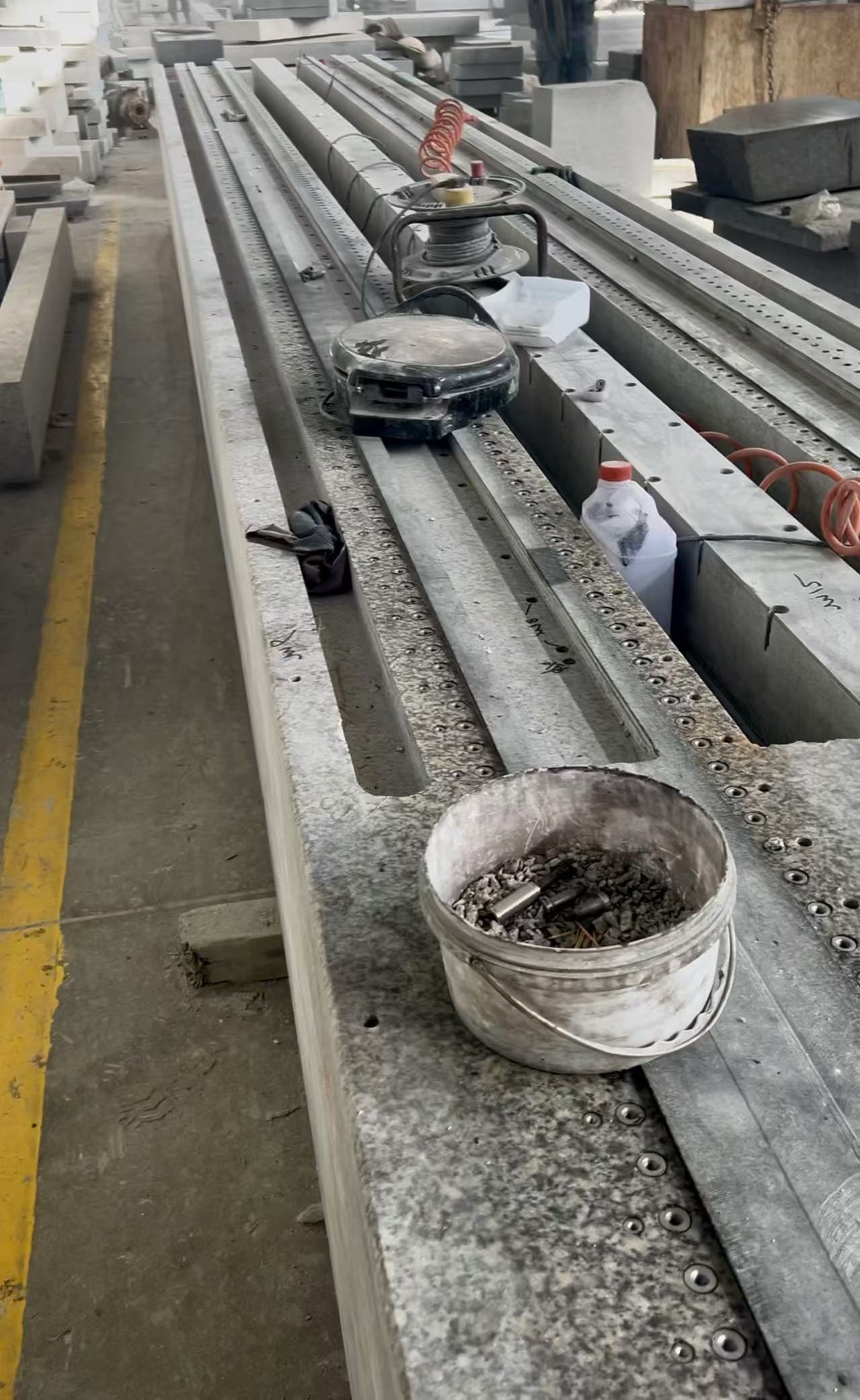
Solution Overview
Designed specifically for CNC lathes, vertical/horizontal machining centers, precision grinders, jig boring machines, and other machine tools, these granite/marble machine tool components focus on “micron-level reference precision, all-operating-condition anti-interference, and in-depth adaptation to machine tool systems”. They address three key pain points of traditional metal machine tool components: “precision drift caused by thermal deformation, machining quality impact from vibration transmission, and increased gaps due to long-term wear”.
Leveraging the ultra-low thermal expansion coefficient (5-9×10⁻⁶/℃), high rigidity (elastic modulus 60-80GPa), and excellent vibration damping performance (vibration attenuation rate ≥ 85%) of high-density natural stone, they provide full-process precision structural support for machine tools—from bases to guideways. This ensures the machine tool achieves a positioning accuracy of ≤ 0.002mm/1000mm and a machining precision attenuation rate of ≤ 0.05% per year, meeting the high-precision machining needs of automotive precision parts, aerospace components, and molds. These components help double the service life of machine tools and reduce maintenance costs by 60%.
Core Function System
1. Precision Reference and Guide Support
- Ultra-High Precision Reference Surfaces: High-density granite (quartz content ≥ 65%, density ≥ 2.7g/cm³) or high-purity marble (calcium carbonate content ≥ 98%, density ≥ 2.75g/cm³) is selected and processed through the “CNC rough milling – multi-pass fine grinding – nano-level polishing” process. The flatness of the machine tool base is ≤ 0.003mm/1000mm, the straightness of the guideway surface is ≤ 0.002mm/1000mm, and the surface roughness is Ra ≤ 0.01μm. This provides nano-level reference support for the machine tool spindle and worktable, avoiding reference deviation of metal bases caused by stress release.
- High-Load-Bearing Guide Structure: Guideways adopt an integrated (non-spliced) design in V-shape/rectangular/dovetail shapes, with a groove width tolerance of ±0.003mm. The groove surface hardness reaches HS75-80 (for granite). When matched with granite sliders, the worktable movement accuracy is ≤ 0.001mm/1000mm—4 times higher than that of metal guideways (accuracy ≤ 0.005mm/1000mm). A single guideway can be up to 6m in length, and the multi-segment splicing error is ≤ 0.002mm, meeting the high-precision guiding requirements for the full stroke of large machine tools.
- Uniform Stress Bearing: Machine tool columns adopt an “integral casting + thickened wall” structure (wall thickness 60-180mm) with a compressive strength of ≥ 180MPa. The load-bearing capacity of a single column ranges from 30 to 150 tons. Under long-term loads from the spindle box and tool magazine (≤ 20 tons), the deformation is ≤ 0.0008mm/m, ensuring stable perpendicularity between the spindle and the worktable and avoiding perpendicularity deviation during machining.
2. Stable Operation with Anti-Interference Under All Operating Conditions
- Ultra-Low Thermal Deformation Suppression: The thermal expansion coefficient of granite/marble is only 1/2 that of cast iron (cast iron: 11×10⁻⁶/℃) and 1/3 that of steel (steel: 13×10⁻⁶/℃). Under local high temperatures (≤ 80℃) generated by high-speed spindle rotation (8000-20000rpm), the thermal deformation of a 1m-long guideway is ≤ 0.001mm. This avoids guideway gap changes caused by thermal deformation and ensures consistent machining dimensions (within a dimensional tolerance of ±0.002mm).
- Efficient Vibration Isolation: The internal damping coefficient of natural stone is 4-6 times that of cast iron, which can absorb high-frequency vibrations (50-3000Hz) generated by machine tool spindle cutting and servo motor operation. The vibration amplitude is reduced from 0.015mm (for metal components) to 0.003mm. Elastic anti-vibration pads (vibration damping efficiency ≥ 90%) are installed at the bottom of the base to further isolate vibrations from the workshop floor, reducing the impact of vibrations on machining surface roughness (Ra reduced from 1.6μm to 0.8μm).
- Corrosion Resistance and Wear Durability: Component surfaces undergo “phosphating + nano-ceramic coating” treatment (coating thickness 5-10μm), withstanding industrial reagents such as cutting fluids, emulsions, and rust inhibitors—eliminating rust and oxidation issues of metal components. The wear resistance of guideway surfaces is 2.5 times that of metal guideways. After long-term use (≥ 200,000 worktable movements), the wear amount is ≤ 0.001mm, eliminating the need for frequent guideway regrinding and extending the machine tool maintenance cycle.
3. Integration and Adaptation to Machine Tool Systems
- Collaborative Installation of Multiple Components: The base reserves mounting holes (φ12-φ30mm, hole position tolerance ±0.005mm) and positioning pin holes (tolerance H6) for the spindle box and servo motor. The worktable reserves T-slots (slot width 10-30mm, tolerance ±0.005mm) for fixture installation, adapting to clamping equipment such as hydraulic fixtures and vacuum chucks and reducing precision loss caused by intermediate connectors.
- Cable and Cooling Integration: Concealed cable channels (aperture 20-50mm) and spindle cooling water channels (aperture 10-20mm) are opened inside the column, adapting to the layout of servo motor cables and spindle cooling pipelines. This avoids cable dragging affecting the movement accuracy of the worktable. The inner walls of the water channels are smoothed to reduce coolant flow resistance and improve heat dissipation efficiency.
- Adaptation for Detection and Calibration: A grating scale mounting slot (width 15-30mm, depth 5-10mm) is reserved on the side of the guideway, and laser interferometer calibration reference points (interval 500mm, accuracy ±0.0005mm) are set on the base. This facilitates regular precision calibration of the machine tool without disassembling core components, improving calibration efficiency by 80%.
Core System Composition
| Component Category |
Core Parameters and Configuration |
| Machine Tool Base (Granite) |
Material: High-density Jinan Green granite (water absorption rate ≤ 0.05%, impurity content ≤ 0.1%); Precision: Flatness ≤ 0.003mm/1000mm, parallelism ≤ 0.005mm/2000mm; Dimensions: Standard 1000×800mm ~ 5000×3000mm, thickness 200-500mm; Structure: With mounting holes for anti-vibration pads, integrated cable channels |
| Machine Tool Guideway (Granite) |
Material: Same as the base; Precision: Straightness ≤ 0.002mm/1000mm, groove width tolerance ±0.003mm, surface Ra ≤ 0.01μm; Dimensions: Length 1000-6000mm (single segment), cross-section 30×50mm ~ 80×120mm; Type: V-shaped/rectangular/dovetail-shaped, adapting to sliding/rolling sliders |
| Machine Tool Worktable (Granite) |
Material: Same as the base; Precision: Flatness ≤ 0.002mm/1000mm, parallelism ≤ 0.003mm/2000mm; Dimensions: 500×500mm ~ 3000×2000mm, thickness 80-200mm; Structure: With T-slots (slot width 10-30mm) and fixture positioning holes |
| Machine Tool Column (Granite) |
Material: Same as the base; Precision: Perpendicularity ≤ 0.002mm/1000mm (to the base connection surface), flatness ≤ 0.003mm/1000mm; Dimensions: Height 1000-4000mm, cross-section 200×200mm ~ 500×500mm; Structure: With spindle box mounting spigots, integrated cooling water channels |
| Auxiliary Components |
Elastic anti-vibration pads (vibration damping efficiency ≥ 90%); Granite guideway sliders (movement accuracy ≤ 0.001mm/1000mm); High-precision connecting bolts (stainless steel Grade H6); Grating scale mounting brackets |
Typical Industry Application Cases
- Vertical Machining Center: A machine tool manufacturer uses it for an 850-type vertical machining center (spindle speed 12000rpm) — adopting a granite base + guideway (1800×1000mm). The positioning accuracy is improved from ±0.005mm to ±0.002mm, and the surface roughness Ra of machined aluminum alloy molds is reduced from 1.2μm to 0.6μm. The mold yield is increased by 30%, and the maintenance cycle is extended from 6 months to 12 months.
- Precision Grinder: An aerospace enterprise uses it for a cylindrical grinder (processing aero-engine shaft parts) — replacing the metal worktable with a granite worktable (1200×500mm) with a flatness of ≤ 0.002mm/1000mm. The roundness error of shaft parts is reduced from ±0.003mm to ±0.001mm, meeting aerospace-grade precision requirements, and the inspection rework rate is reduced from 8% to 1%.
- Large CNC Lathe: A heavy industry enterprise uses it for a 6m CNC lathe (processing wind turbine main shafts) — adopting granite guideways (3m single segment, spliced to 6m). The guideway straightness is ≤ 0.003mm/6000mm, and the parallelism error between the spindle and the guideway is ≤ 0.002mm. The cylindricity error of the wind turbine main shaft is reduced from ±0.01mm to ±0.003mm, and the machining efficiency is increased by 25%.
Core Competitive Advantages
- High Precision Barrier: The flatness of reference surfaces and straightness of guideways both reach micron-level (Grade 00 precision), far exceeding metal components (Grade 0 precision). It is the only feasible structural solution for precision machine tools (machining accuracy ≤ 0.005mm), especially suitable for high-end machining scenarios such as aerospace and precision molds.
- Strong Long-Term Stability: After 24-36 months of natural aging treatment, 99.5% of internal stress is eliminated. The precision retention period is 5-8 years (only 2-3 years for metal components), reducing machine downtime for frequent calibration and saving enterprises over 200 hours of operation and maintenance losses annually.
- Low Comprehensive Cost: The initial purchase cost is 20%-30% higher than that of metal components, but there are no maintenance costs such as rust prevention and guideway regrinding required for metal components. With a doubled service life, the total lifecycle cost is over 50% lower than that of metal components.
- Flexible Adaptability: Customized special-shaped structures (e.g., stepped bases, multi-station worktables) are supported, adapting to different types of machine tools such as CNC lathes, grinders, and machining centers. Mounting holes and interfaces can be customized according to machine tool models (e.g., FANUC, SIEMENS system machines) to achieve “plug-and-play”.
Full-Dimensional Customization Services
Dimension and Structure Customization
- Component Dimensions: Bases range from 1000×800mm to 8000×5000mm; guideways range from 1000-6000mm (single segment); worktables range from 500×500mm to 3000×2000mm — all designed on demand.
- Special Structures: Customized stepped bases (adapting to multi-spindle machines), multi-station worktables (with partitioned T-slots), and columns integrated with cooling water channels to meet personalized machine tool needs.
Precision and Function Customization
- Precision Grades: Grade 00 (flatness ≤ 0.003mm/m) and Grade 0 (≤ 0.005mm/m). Grade 00 is selected for precision grinders/machining centers, and Grade 0 for conventional lathes.
- Function Enhancement: Nano-level polishing of guideway surfaces (Ra ≤ 0.008μm), anti-static surface treatment (surface resistance 10⁶-10⁹Ω), and anti-slip treatment of worktables (sandblasting process) — all adapting to special machining environments.
Installation and After-Sales Customization
- Installation and Commissioning: Base level calibration (accuracy ≤ 0.001mm/m) and collaborative commissioning with the machine tool spindle/servo system to ensure the machine tool meets precision standards.
- After-Sales Guarantee: 3-year free warranty, lifelong precision calibration and maintenance, and customizable “quarterly inspection + annual in-depth maintenance” plans.
- Technical Support: Provide component mechanical simulation and machine tool precision optimization suggestions to assist customers in completing the overall machine tool solution design.